

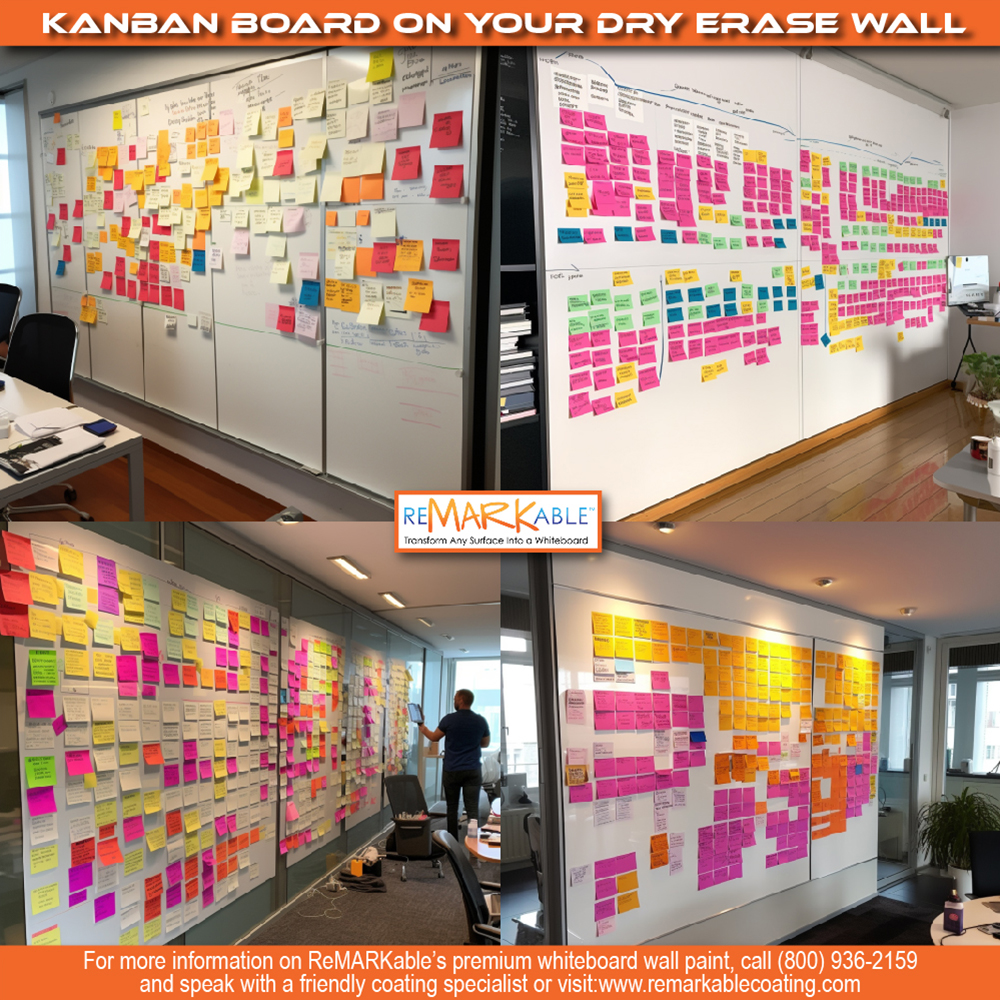
Manage Work Visually with a Kanban Board on Your Dry Erase Wall
Your dry erase wall can be used in many effective ways, even without the latest in pricy high-tech add-ons. For example, the Japanese word “Kanban” conveys the idea of a sign, a poster, or a billboard and literally means “visual board.” The concept comes from the highly efficient Toyota Production System, which relates to a scheme for controlling auto-parts inventory levels. The method was inspired by the cards found on grocery store shelves indicating products that are “out of stock” and need to be quickly resupplied. The Toyota system carefully accounts for current inventory or “work in process” and functions to reduce inventory levels viewed as inefficient and detrimental to optimal performance.
The term “Kanban method” also refers to a tactic for constant development that depends on envisioning the present system of work scheduling and on monitoring “flow” as the vital measure of team performance and overall system optimization. Being a process-enhancement technique, Kanban does not specify exact procedures to follow. Instead, a Kanban board is a physical tool designed to help teams visualize their ongoing efforts, control workflow, and maximize productivity, thus creating order in the environment.
How Does the Kanban Method Work?
Kanban boards divide a project into modules or columns, helping teams keep track of all their tasks through the various stages of completion and allowing everyone involved to be constantly aware of the moving pieces. Using this method in conjunction with a premium dry erase painted wall can help your team turn ideas into actions and actions into great organizational success.
As mentioned, a Kanban board serves the vital role of a workflow-visualizing tool, and many consider it to be the ultimate real-time form of project status report. With a quick glance at a Kanban board on your dry erase wall, whether in-person or remotely, stakeholders can observe which projects are in progress, which have already been completed, and which are next in line to be worked on.
Although it may seem that Kanban boards are more suited to being tools for use in project management, they’re also quite helpful in meeting the needs of product managers. In providing a general, clear-cut view of where matters are at any given moment, the boards can be highly beneficial for all types and sizes of product-development teams. In addition, Kanban boards do away with the constant requests for status updates from stakeholders and upper management and provide an immediate view of an initiative’s current state of progression.
Kanban Boards Also Have Educational Value
The visual and sequential qualities of Kanban boards also make them great educational tools. They ensure that everyone on your team and everyone involved in a work project or product-development effort is informed of and understands every stage and gateway an undertaking must go through before it ultimately reaches end users.
Visually Track Your Work Using a Dry Erase Wall Kanban Board
The visual portrayal of items on a dry erase Kanban board conveys the status of various organizational priorities, as the items’ place in each column on the board indicates their relative degree of importance. In addition, compared to views of workflow based on timelines, Kanban boards help to shift an organization’s focus from precise dates or deadlines to simply getting projects done as quickly as possible. Kanban boards also facilitate the maximum and most productive use of resources, as they eliminate confusion by keeping team members continually informed of what specific tasks they need to tackle next in a project.
Steps to Creating a Kanban Board on Your Dry Erase Wall
A Kanban board can be set up on a dry erase wall in a matter of minutes. But spending some time contemplating your board’s precise purpose will make it far more helpful for your team in the long run. Dry erase Kanban boards use written notes, columns, and continuous updating and improvement to help teams commit to the proper amount of work and get it done in a timely manner.
A physical Kanban board is easy to create in a home office, business workplace, health care facility, or other setting. The critical component is a dry erase painted wall that people not directly involved in a project won’t disturb throughout the project’s duration, along with an ample supply of multi-colored low-odor dry erase markers.
Once completed, a Kanban board on your dry erase wall will allow for spur-of-the-moment “Kanban-ing” sessions to brainstorm new project ideas, prioritize work activities, and plan strategy, during which color-coding and rearranging items on the board can be a fun and interactive process for your team.
A physical Kanban board can work well for teams operating in the exact location but may also be easily used by those working remotely through virtual meetings. With distributed teams and remote work becoming increasingly common these days, the virtual-meeting Kanban approach can be highly practical for ongoing use and reference by your team.
Organize Tasks and Keep on Target with a Dry Erase Kanban Board
On the typical Kanban board, tasks are placed into one of three categories based on their completion stage. The Kanban method allows teams to quickly and efficiently maximize their workflow and productivity by displaying tasks in context. The following are the steps in building a dry erase Kanban board for your team.
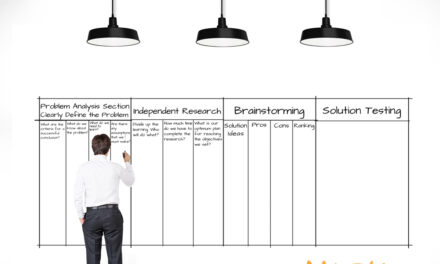
1. In an area of your dry erase wall that everyone can easily see, use a low-odor dry erase marker to draw four large vertical columns with a ruler or yardstick. Then write evenly-spaced headers at the top of each column. For example, write “Owner” above the first column, “To-Do” above the second, “In-Process” above the third, and “Done” above the fourth.
2. Next, assign each team member a specific dry erase marker color. Ask everyone to write their name and the titles of their tasks using their assigned color of ink in the “To-Do” column.
3. Each team member should then choose one of the tasks they plan to start with, erase it from the To Do column, and write it in the In-Process column. Afterward, your workers can continuously update the status of their tasks by erasing them and moving them to the right until the tasks are completed and posted in the Done column.
Using this system, you and your team can easily monitor a project’s progress and maintain its momentum in the office environment. But what if some or all of your team members are operating remotely? To help teams work efficiently no matter where they’re located, you can make changes to your dry erase Kanban board during virtual meetings by doing the following.
1. As with the in-person meeting, before the first virtual meeting, use a low-odor dry erase marker to draw four large columns, then write evenly spaced headers at the top of each column. For example, write “Owner” above the first, “To-Do” above the second, “In-Process” above the third, and “Done” above the fourth.
2. Then, once the meeting starts, begin making a video of the Kanban board and assign each team member a specific dry erase marker color. Write down their names and the titles of their tasks in the To-Do column using their assigned color of ink.
3. Next, ask each team member to choose one of the tasks they plan to start with, erase it from the To Do column, and write it in the In-Process column. Afterward, at subsequent virtual meetings, you can continuously update the status of the team’s tasks by erasing them and moving them to the right until the tasks are all in the Done column. At these meetings, you and your team may also discuss the progress of the work, any feedback they may want to contribute about expediting the project, and the like.
Using this approach, you can virtually manage your dry erase Kanban board, your work projects, and your team members, no matter where they may be located. When you have a dry erase wall and a Kanban board as tools, you can find solutions to any type of challenge. Use the Kanban board approach to awaken your team’s shared desire to achieve remarkable results while working together.



![Giant Leaps Forward Require Big Spaces. [Leap Year Sale Event!]](https://www.remarkablecoating.com/wp-content/uploads/2016/02/Giant-Leaps-ForwardRequire-Big-Spaces-440x264.jpg)



![30% Off St Patrick’s Day Sale! [Details Inside]](https://www.remarkablecoating.com/wp-content/uploads/2016/03/Glorious-1-440x264.png)

![Drive Your Organization Into Openness and Watch it Expand [20% Off Whiteboard Paint]](https://www.remarkablecoating.com/wp-content/uploads/2016/04/Drive-Your-Organization-Into-Openness-and-Watch-It-Expand.-1-440x264.jpg)















![ReMARKable’s Winter Sale is Here! [25% Off + Free Shipping]](https://www.remarkablecoating.com/wp-content/uploads/2018/01/Red-Tag-Winter-Fashion-Facebook-Post-1-440x264.png)




![ReMARKable Summer Sale 2018 [28% Off Whiteboard Paint]](https://www.remarkablecoating.com/wp-content/uploads/2018/06/Blue-Simple-Line-Beach-Facebook-Post-1-440x264.png)











































































































































































































0 Comments