

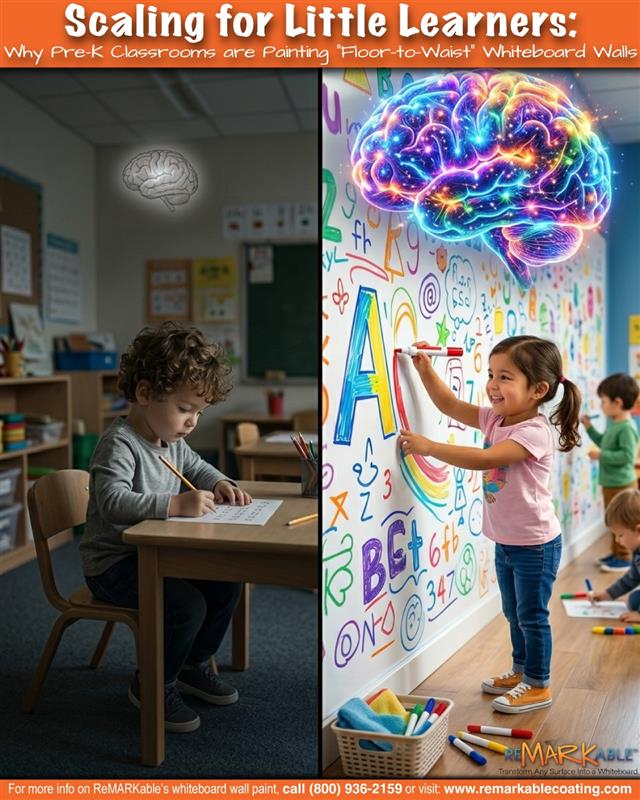
Why Pre-K Classrooms are Painting “Floor-to-Waist” Whiteboard Walls
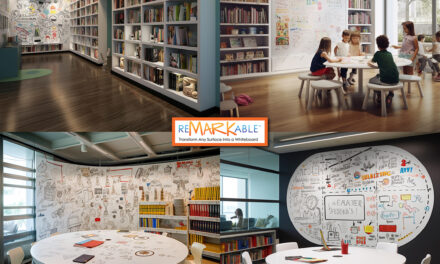
Having a whiteboard wall in the pre-K classroom is vital to shaping a young child’s educational experience. It serves as a large canvas that promotes students’ learning, social interaction, and personal growth. An effective preschool classroom is one that offers a balance of structure and freedom, enabling children to explore and learn at their own pace. And a wall coated with dry erase paint greatly facilitates this process.
A pre-K classroom design incorporating vertical writing for toddlers enhances both their early childhood motor proficiency and neurocognitive development. Thus, dry erase paint is perfect for preschool directors, kindergarten teachers, and OT specialists seeking to help children develop or improve their essential life skills.
In a standard classroom, the whiteboard might as well be on the ceiling for a four-year-old pre-K student. Standard mounting heights for whiteboards – 36″ off the floor – are designed for adults. This leaves students with only a tiny sliver of space they can actually reach on a whiteboard for writing letters and drawing.
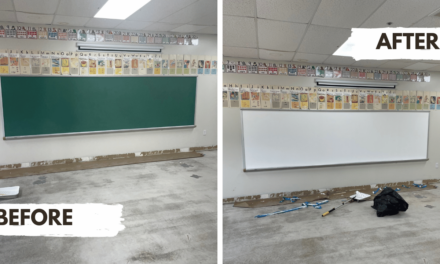
The solution to this problem is to create floor-to-waist or floor-to-ceiling whiteboard walls to accommodate preschoolers’ size. By lowering the canvas for preschoolers, we aren’t just giving kids a convenient place to draw and write. We’re unlocking a way for them to reach critical developmental milestones.
The Science of Vertical Writing: Why Whiteboard Walls Build Better Writers
The OT Angle:
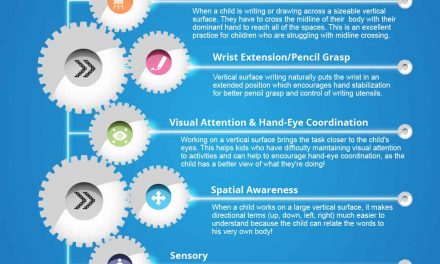
From an occupational therapy (OT) perspective, writing on a whiteboard wall builds children’s shoulder stability and core strength. When whiteboard paint is installed in the preschool classroom, children will naturally go back and forth between the vertical wall and the horizontal surfaces they work on. During this process, they assume different positions, alternating between sitting, standing, kneeling, and hunching over the wall. These physical movements help build their core strength and strengthen their backs.
Without the back of a chair to use for support while working on the wall, children’s back muscles are constantly engaged as they stand upright. This gives them easy access to the wall’s vertical surface and helps them develop an erect posture. As a result, they get a boost in self-esteem and develop a better physical appearance that lasts throughout their lives.
Wrist Development and Pencil Grasp:
Vertical surfaces, such as dry erase walls, are better than flat desks and tables for developing a child’s wrist muscles and mature pencil grip. As all parents know, children learn and develop at their own pace. However, it can be frustrating if, for instance, a three year old still holds writing instruments with their palm and five fingers instead of the more advanced three-fingered pencil grasp.
In such cases, the handy, easy-to-use vertical surface of a whiteboard painted wall offers endless chances for children to extend their wrists. They can also regularly practice the stable hand-and-arm position that leads to a better grip and control of writing implements such as pencils or dry erase markers.
The “Gross Motor” Connection:
The large arm movements children make on a whiteboard wall help stimulate brain development more effectively than making small finger movements on a piece of paper. Early childhood motor skills are thus greatly enhanced.
As mentioned above, while working on a vertical surface like a whiteboard wall, children rarely stay fixed in one position. Instead, they tend to constantly move around between the table, desk or floor and various locations on the wall. This requires them to alternate between standing, kneeling, squatting, and sitting. They also need to use their whole body when bending down to pick up dropped markers and continue to write or draw. In this way children’s gross motor skills are developed for use in other tasks.
Safety and Durability in the “Splash Zone”
Frame-Free Safety: When you coat your preschool classroom walls with dry erase paint, you eliminate the danger of having sharp metal frames and corners located in play areas. Sharp corners increase the chances of injuries. The most common concern with sharp edges in the classroom’s “splash zone,” where students might bump into the wall, is injury, such as a laceration or puncture.
This concern is avoided when the kids work on a smooth, frame-free dry erase wall. They can make as much contact with the wall as they want without suffering any wounds that break the skin.
Student-Proof Surfaces: Unlike adhesive whiteboard films that can be peeled or picked at by curious little fingers, a whiteboard painted surface is permanent, seamless, and “pick-proof.” Besides being easy to pick at and peel, whiteboard films melt and react poorly to heat and exposure to some liquids.
With whiteboard paint installed, there’s no chance for the children to peel off parts of the surface. That’s because whiteboard paint cures into a protective, resilient, and non-porous skin that can withstand the rigors of being in a preschool classroom.
Sanitization: Sanitizing a seamless, non-porous whiteboard wall during flu and cold season is easy. You can just wipe down the surface with a microfiber cloth dampened with denatured alcohol or rubbing alcohol. Then, follow up with another wipe down with a dry microfiber cloth.
Designing for High Energy: Clear Whiteboard Paint over Colored Walls
The Aesthetic Choice: Schools don’t have to look like sterile medical labs or offices. Instead you can make your pre-K classroom look aesthetically pleasing and exciting for your students.
The Hack: Apply Clear ReMARKable Whiteboard Paint over bright “early ed” colors such as sunny yellow or sky blue.
The Result: In this way, your dry erase wall stays fun and vibrant for the children, and becomes a functional tool for learning letters and shapes as well.
Three Pre-K Activities for Your New Whiteboard Wall
-
The “Life-Size” Self-Portrait:
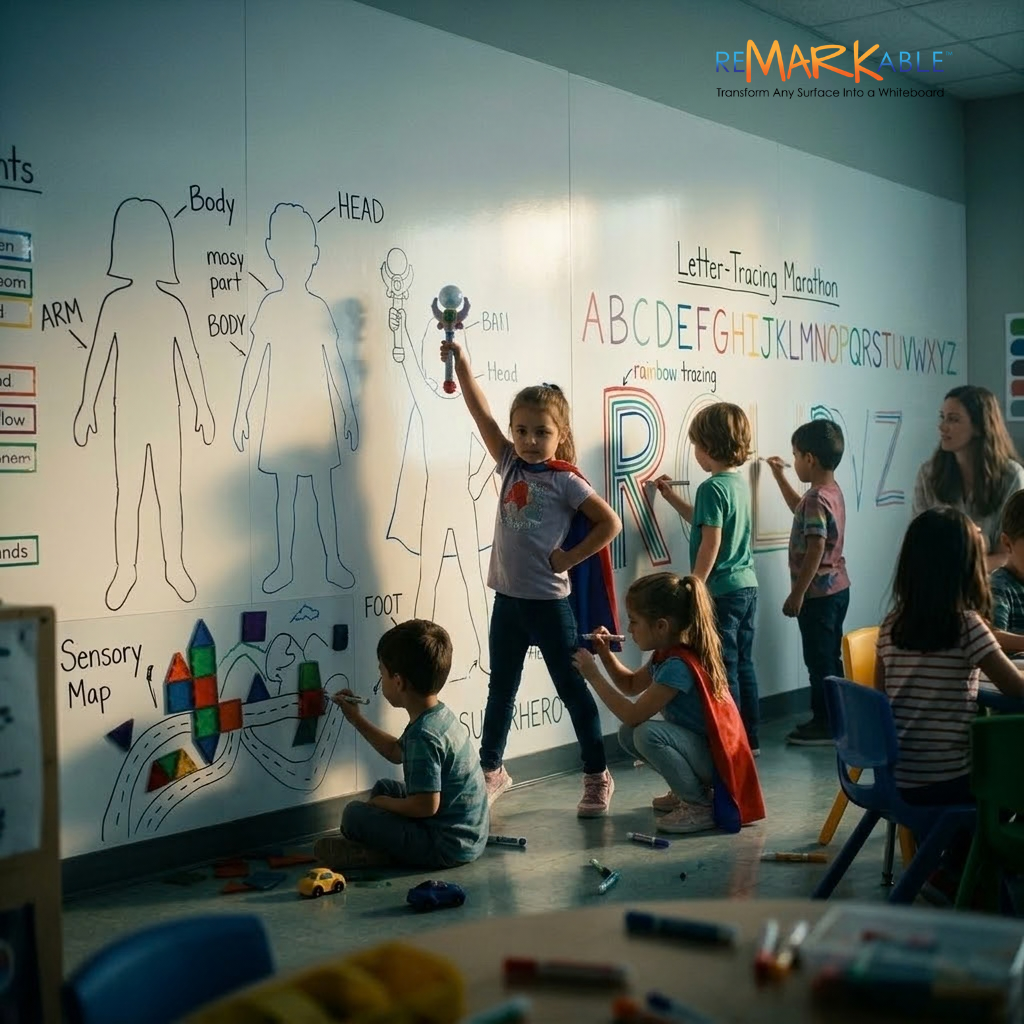
Have the children stand next to the whiteboard wall, trace the outlines of each other’s bodies on the wall, and identify the names of the various body parts. They can get creative with the poses, such as waving, stretching, or assuming a superhero pose. You can also include props for them to hold.
-
The Letter-Tracing Marathon:
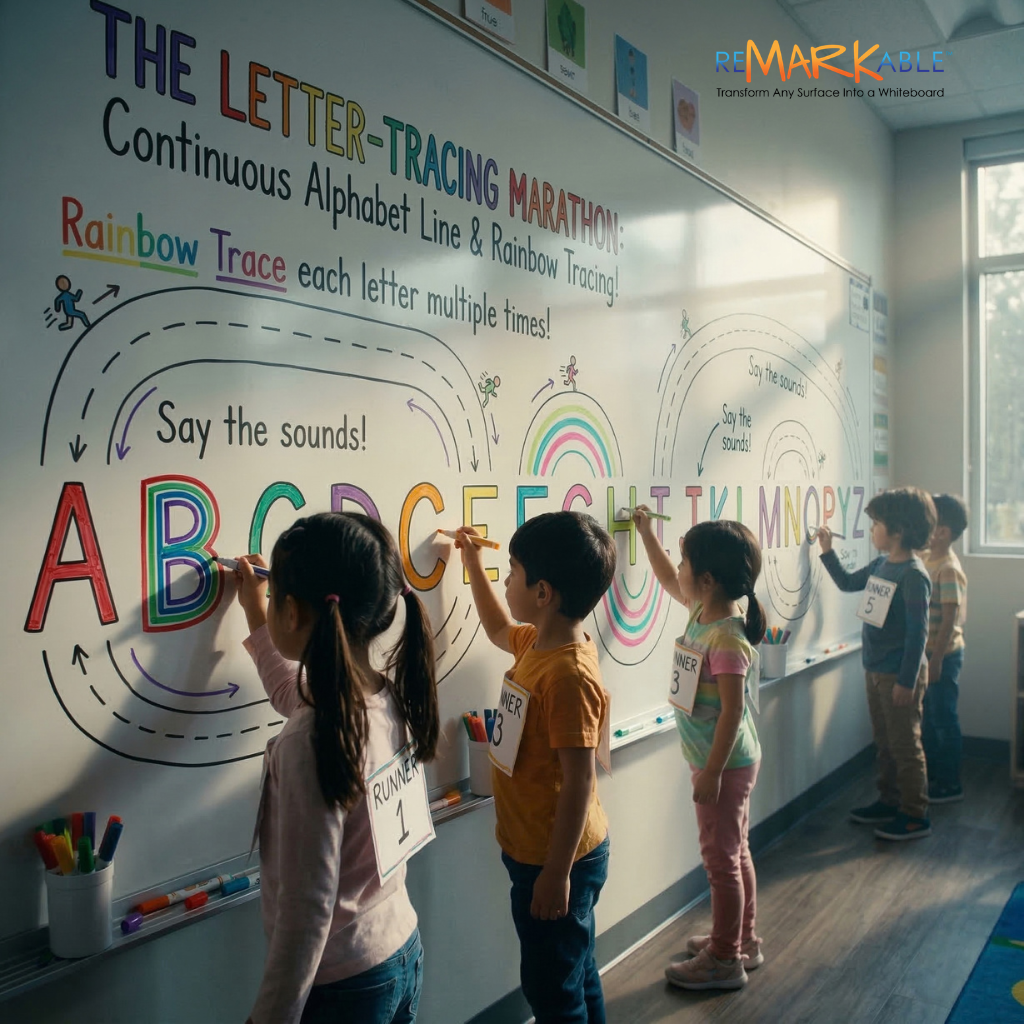
Use the wall to have the students create a continuous alphabet line. They can do “rainbow tracing” where they trace the same letter multiple times using different colored dry erase markers. You can also encourage them to say the sounds of the letters out loud as they trace to reinforce sound associations.
-
The Sensory Map:
Have the students use magnets (if you have magnetic primer installed) and dry erase markers to create interactive 3D landscapes.
If we want our pre-K learners to think big, we have to give them a big enough writing and drawing canvas on which to express their creativity. Are you ready to scale your classroom to accommodate your smallest students? Request a Pre-K Volume Quote for our floor-to-ceiling whiteboard paint kits today.
FAQs
Q: At what height should the paint start?
A: To accommodate the height of pre-K students, start installing whiteboard paint at the baseboard (four inches off the floor) and go up at least 48 inches. Alternatively, you can apply the paint from floor to ceiling to let the teachers easily use the wall as well.
Q: Is the paint safe for kids with allergies?
A: Yes, whiteboard paint’s high-quality formula is low in volatile organic compounds (VOCs), and free of toxic isocyanates. Thus, with whiteboard walls it’s easy to maintain good indoor air quality, which is essential for early childhood learning environments.
Q: Can you use magnets on the walls?
A: Yes, if you apply a magnetic primer under the dry erase paint. To do so, apply several light coats instead of a single heavy coat. Magnetic primers produce a magnetic surface for use with basic magnets. However, it’s important to also apply a coat of satin or eggshell water-based paint over the primer as a base coat. In this way you’ll ensure proper adhesion of your ReMARKable Whiteboard Paint topcoat.



![Giant Leaps Forward Require Big Spaces. [Leap Year Sale Event!]](https://www.remarkablecoating.com/wp-content/uploads/2016/02/Giant-Leaps-ForwardRequire-Big-Spaces-440x264.jpg)



![30% Off St Patrick’s Day Sale! [Details Inside]](https://www.remarkablecoating.com/wp-content/uploads/2016/03/Glorious-1-440x264.png)

![Drive Your Organization Into Openness and Watch it Expand [20% Off Whiteboard Paint]](https://www.remarkablecoating.com/wp-content/uploads/2016/04/Drive-Your-Organization-Into-Openness-and-Watch-It-Expand.-1-440x264.jpg)

















![ReMARKable’s Winter Sale is Here! [25% Off + Free Shipping]](https://www.remarkablecoating.com/wp-content/uploads/2018/01/Red-Tag-Winter-Fashion-Facebook-Post-1-440x264.png)




![ReMARKable Summer Sale 2018 [28% Off Whiteboard Paint]](https://www.remarkablecoating.com/wp-content/uploads/2018/06/Blue-Simple-Line-Beach-Facebook-Post-1-440x264.png)



















































































































































































































































0 Comments