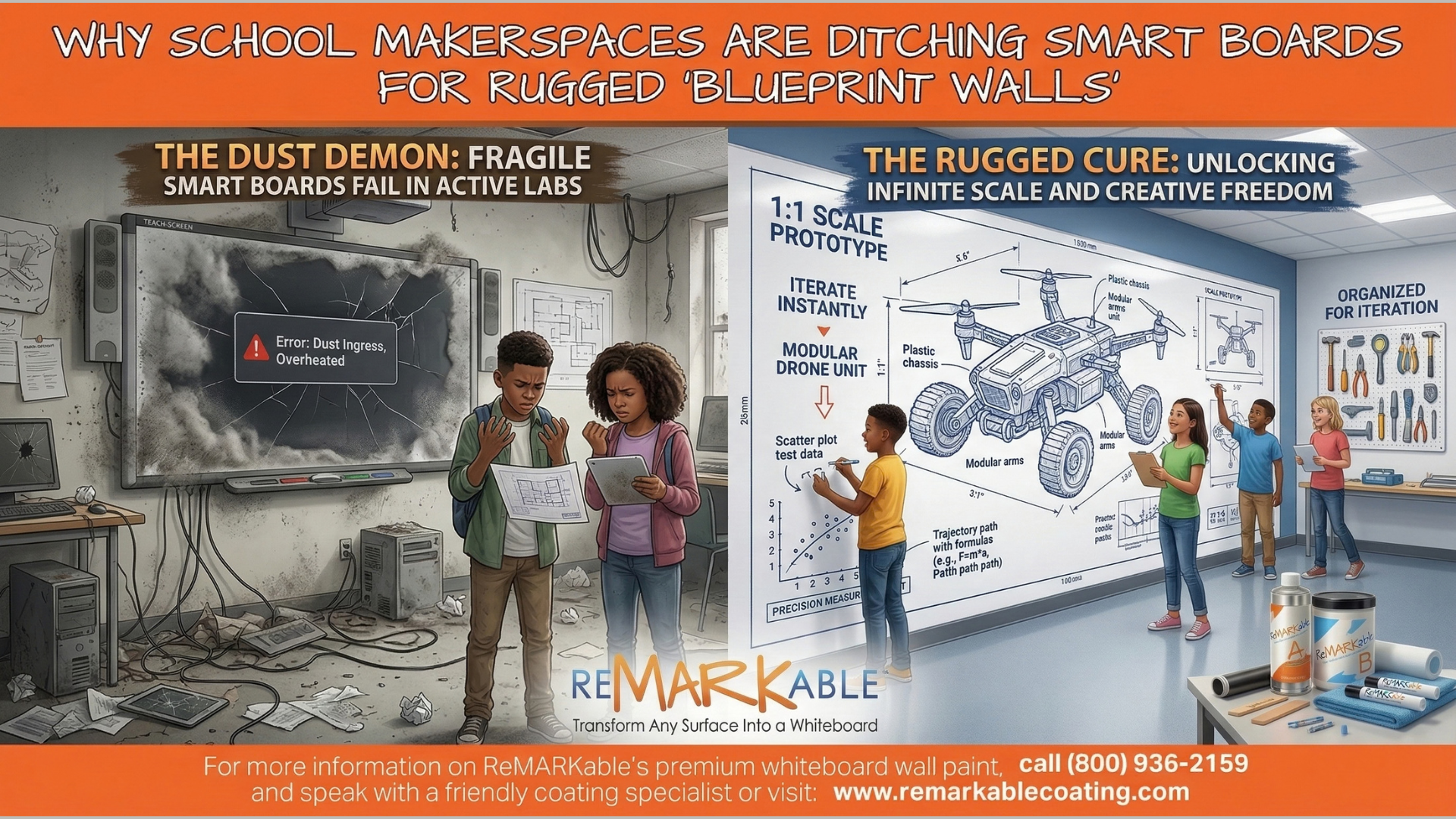
Why School MakerSpaces are Using Whiteboard Paint for “Blueprint Walls”
In recent years, STEM educators have eagerly embraced the makerspace movement, increasingly utilizing whiteboard paint for “Blueprint Walls” to encourage hands-on class work and innovative problem solving that mimics the real world. Makerspaces enable students to bring their ideas to fruition through applied design, engineering, testing, and prototype refinement. These highly creative zones include a range of devices and engineering materials, from laser cutters and 3D printers to electronics, hand tools, and handicraft supplies.
Due to their clear benefits for STEM instruction, school makerspace ideas are in great demand. The makerspace is the crown jewel of many of today’s schools, but designing one is completely different from designing a standard classroom. STEM coordinators, science department heads, and architects need to carefully consider which learning tools to include in these highly active workshops.
Schools want to keep up with the pace of advances in makerspace design. So, they mistakenly fill their STEM classroom innovation spaces with fragile, expensive smart boards that soon get damaged by dust, glue, flying robot parts, and other debris. Ironically, the ideal technology for such a high-tech room is analog in nature – a “blueprint wall” created with whiteboard paint. This blog post will explain why top STEM coordinators are ditching digital smart board screens for wraparound walls coated with dry erase paint to enhance the engineering design process.
Why Smart Boards Fail in the MakerSpace
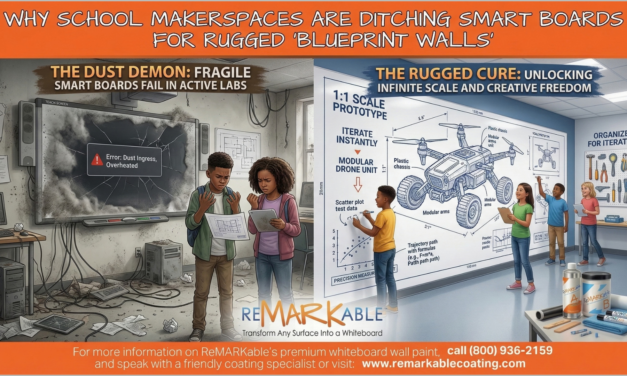
The Environment of a typical STEM lab includes items such as cutting-edge smart boards, CNC routers, soldering irons, and 3D printers. However, airborne dust particles from working in the vicinity of smart boards eventually damage the expensive cooling fans and touch sensors of digital displays. They also seep into the casings of other digital devices nearby.
Standard interactive flat panels, aka smart boards, have low IP (Ingress Protection) ratings for dust. That’s because their cooling fans pull particulate matter into their motherboards, causing screens of up to $7,000 to overheat and die after a few years of use.
To address this problem, you can apply the durable, eco-friendly “analog armor” of dry erase paint to your walls. Doing so turns the drywall in your makerspace into a rugged, tech-free, collaboration hub that won’t be impacted by dust, or damaged by ultraviolet light, stray drones, or robots. STEM lab designs that incorporate whiteboard paint ensure that students can learn effectively, even if particulate matter and debris damage their high-tech devices.
The “Blueprint Wall”: Supporting the Engineering Design Process
- The Standard: The Next Generation Science Standards (NGSS) mandate that students engage in the “Engineering Design Process,” which requires a strong emphasis on modeling, prototyping, and iteration.
- The Application: You can’t effectively prototype a four-foot robotics chassis on a small piece of drafting paper. Instead, STEM students need “blueprint walls” — huge vertical surfaces where they can draw 1:1 scale models, erase them, and iterate instantly.
- Scale Matters: When students need to draw 1:1 scale models of their projects (e.g., CO2 dragsters or VEX robots), a 4 x 8 whiteboard just isn’t big enough to accommodate the images. In contrast, a “blueprint wall” coated with dry erase paint provides more than enough room for students to work out their ideas in full.
- Iteration: The core of the STEM design process is trying, failing, and trying again in a continuous cycle of experimentation. The “non-permanent” nature of a whiteboard wall encourages students to sketch, wipe away, and redesign their ideas without the permanence or waste produced by using drafting paper.
- Data Tracking: Physics and chemistry students can use the lab’s large, open-ended whiteboard walls to map out large-scale scatter plots and trajectory equations during live experiments. As with scale models, the vast area of a whiteboard wall allows students to write and draw to their heart’s content when doing such work.
Chemical and Impact Resistance: Not All Whiteboards Are Created Equal
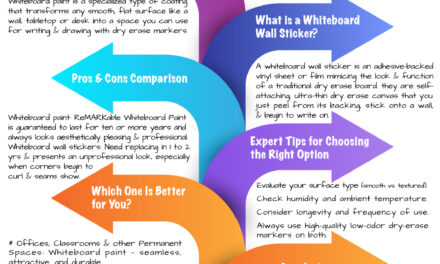
- Warning: Schools should avoid installing cheap adhesive whiteboard films in their labs. These products melt, peel, and react poorly to heat and chemical exposure. They’re often more textured than whiteboard paint, so they reduce pen glide and cause thin-tipped dry erase markers to skip. Over time, erasing whiteboard films may also cause more ghosting to occur than would occur with dry erase paint due to their lower-quality chemical composition.
The Science of Paint: In contrast, professional-grade whiteboard paint cures to produce a highly durable, protective, non-porous wall coating that can withstand the rigors of use in a STEM lab. The paint consists of a two-part water-based aliphatic polyurethane formulation that’s highly resistant to UV radiation and scratching.
Aliphatic polyurethane formulas, like that of premium dry erase paint are composed of multiple straight chains of urethane, a synthetic crystalline compound that has great strength and elasticity. The molecular forces in polyurethanes are spring-like and feature strong attractions, causing polyurethane compounds to be flexible, tough, and resilient.
So, they hold up even under extreme temperatures and physical stress. These traits make ReMARKable whiteboard paint appropriate for installation in all types of environments, where it can withstand long-term use with proper maintenance.
1. The Workbench Top: Don’t just paint the walls of your lab. Paint the tops of your wooden or steel workbenches as well so that students can write measurements and draw diagrams right next to the work they’re doing. Whiteboard paint applied on workbench surfaces also allows students to make notes and brainstorm ideas and images for their STEM projects.
2. The Tool Shadow Board: Apply dry ease paint to the wall behind your hand and power tools. Then draw outlines or shadows of the tools so students know exactly where to return their hammers, screwdrivers, clamps, and wrenches.
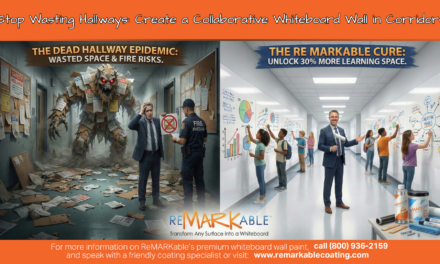
3. The 360-Degree Ideation Room: Coat all four walls of your STEM lab to allow multiple robotics teams and others to work in the same room at the same time without fighting over whiteboard space. The walls’ vast surfaces can accommodate all the text and image groups students create as they work together on the same project.
The best way to support high-tech STEM learning in your school is to provide your students with a large, unconstrained, and highly resilient writing and drawing canvas for generating and refining ideas. Are you building or renovating a STEM lab makerspace in your school this summer? If so, you can protect your budget and expand your options for communication and experimentation with dry erase paint. Shop our
top-quality Whiteboard Paint kits today.
FAQs: Upgrading Your Lab with Dry Erase Paint
Q: Can we project computer code or CAD designs onto the whiteboard wall?
A: Yes! A whiteboard wall doubles as a massive, bezel-free projection screen. With premium whiteboard paint installed on your STEM lab walls, they easily double as high-quality screens for projecting slides, videos, opaque subjects, filmstrips, and computer images. Dry erase paint’s low-odor, water-based formula produces a superior writing canvas with minimal glare that’s ideal for use as a projection screen.
Q: Can the surface withstand impact from flying objects such as stray robotics parts?
A: Yes. ReMARKable cures to produce a tough, non-porous wall coating. It’s more impervious to dents and abrasions than matte latex wall paint. The coating consequently acts as a defensive armor for your drywall.
Q: Can we apply the paint to existing metal workbenches and epoxy lab tables?
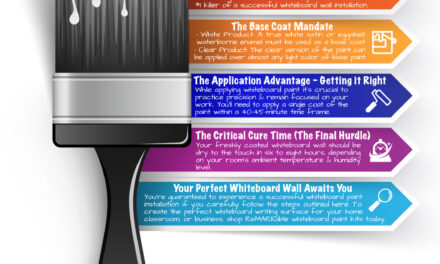
A: Yes, whiteboard paint isn’t just for drywall. It can be applied to any smooth flat surface as long as the proper primer and base coat are applied beforehand. You’ll need to lightly sand the surface to reduce the sheen. Then apply any high-bonding primer followed by a proper base coat of satin or eggshell water-based paint. Finally, apply the whiteboard paint according to the manufacturer’s instructions.
Q: Is the paint safe to apply in a school environment?
A: Yes, the high-quality formula used to make whiteboard paint is low in volatile organic compounds (VOCs) and is thus safe for indoor institutional use. In fact, premium whiteboard paint’s extremely low VOC content has led Leadership in Energy and Environmental Design (LEED) to certify it as an eco-friendly wall coating.




![Giant Leaps Forward Require Big Spaces. [Leap Year Sale Event!]](https://www.remarkablecoating.com/wp-content/uploads/2016/02/Giant-Leaps-ForwardRequire-Big-Spaces-440x264.jpg)



![30% Off St Patrick’s Day Sale! [Details Inside]](https://www.remarkablecoating.com/wp-content/uploads/2016/03/Glorious-1-440x264.png)

![Drive Your Organization Into Openness and Watch it Expand [20% Off Whiteboard Paint]](https://www.remarkablecoating.com/wp-content/uploads/2016/04/Drive-Your-Organization-Into-Openness-and-Watch-It-Expand.-1-440x264.jpg)

















![ReMARKable’s Winter Sale is Here! [25% Off + Free Shipping]](https://www.remarkablecoating.com/wp-content/uploads/2018/01/Red-Tag-Winter-Fashion-Facebook-Post-1-440x264.png)



![ReMARKable Summer Sale 2018 [28% Off Whiteboard Paint]](https://www.remarkablecoating.com/wp-content/uploads/2018/06/Blue-Simple-Line-Beach-Facebook-Post-1-440x264.png)



























































































































































































































0 Comments