

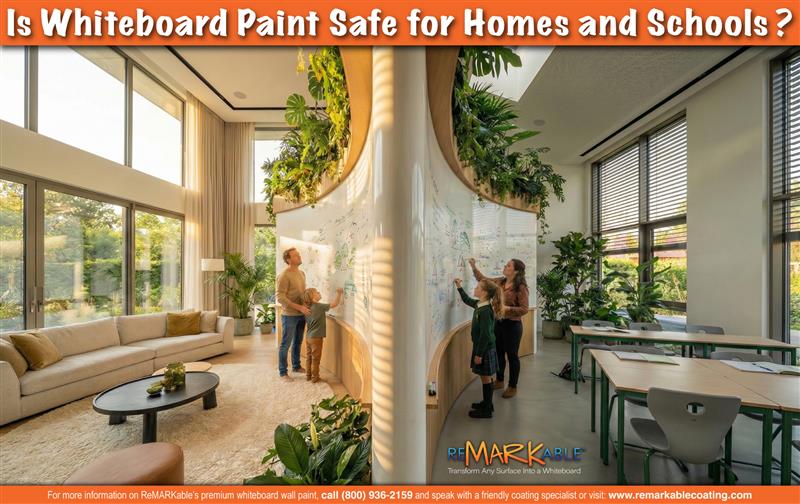
Large writable surfaces have long been used as communication tools in homes, schools, and workplaces. As more people move away from traditional chalkboards and framed whiteboards, many homeowners, educators, and administrators are asking an important question: Is whiteboard paint safe for indoor use?
In this article, we’ll explain what makes whiteboard paint safe or unsafe, how safety differs between schools and homes, and what standards to look for when choosing a dry erase wall solution.
Quick Answer: Is Whiteboard Paint Safe?
Yes, whiteboard paint is safe for schools and homes when it is properly formulated and applied. High-quality whiteboard paints with low VOC levels are designed for indoor use, produce minimal odor, and are safe for environments with children, families, and frequent daily activity.
Some premium whiteboard paints are specifically engineered to meet strict indoor air quality standards and are independently certified for use in schools and residential spaces.
What Makes Whiteboard Paint Safe?
Several key qualities make premium whiteboard paint risk-free to install in any indoor environment, such as a classroom or a private living room.
A. VOC Levels and Indoor Air Quality
As mentioned above, a good whiteboard wall paint must be low in VOC. In other words, the coating emits virtually no volatile organic compounds. VOCs are gases emitted into the air from various processes or products, such as paints, coatings, and household cleaners. While some are harmless, others are damaging to both human health and Earth’s environment, including some that cause cancer.
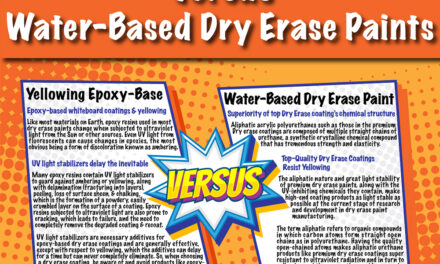
Among the harmful VOCs are those emitted by the epoxy resins in many of our competitors’ whiteboard paint products. Inhaling these chemicals can lead to a wide range of health problems, including eye, nose, and throat irritation; difficulty breathing; nausea; and damage to the brain and spinal cord.
In schools and homes, high VOC content can put the health of students, teachers, and household members in jeopardy. In fact, VOCs in epoxy-based coatings may compromise dry erase wall safety for many years after the coatings are applied. Even after these products have fully cured, they still emit toxic fumes throughout their use. And people exposed to these vapors, especially those with respiratory issues, are always at risk of health problems.
B. Odor and Off-Gassing Concerns
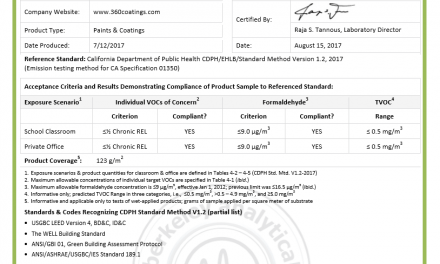
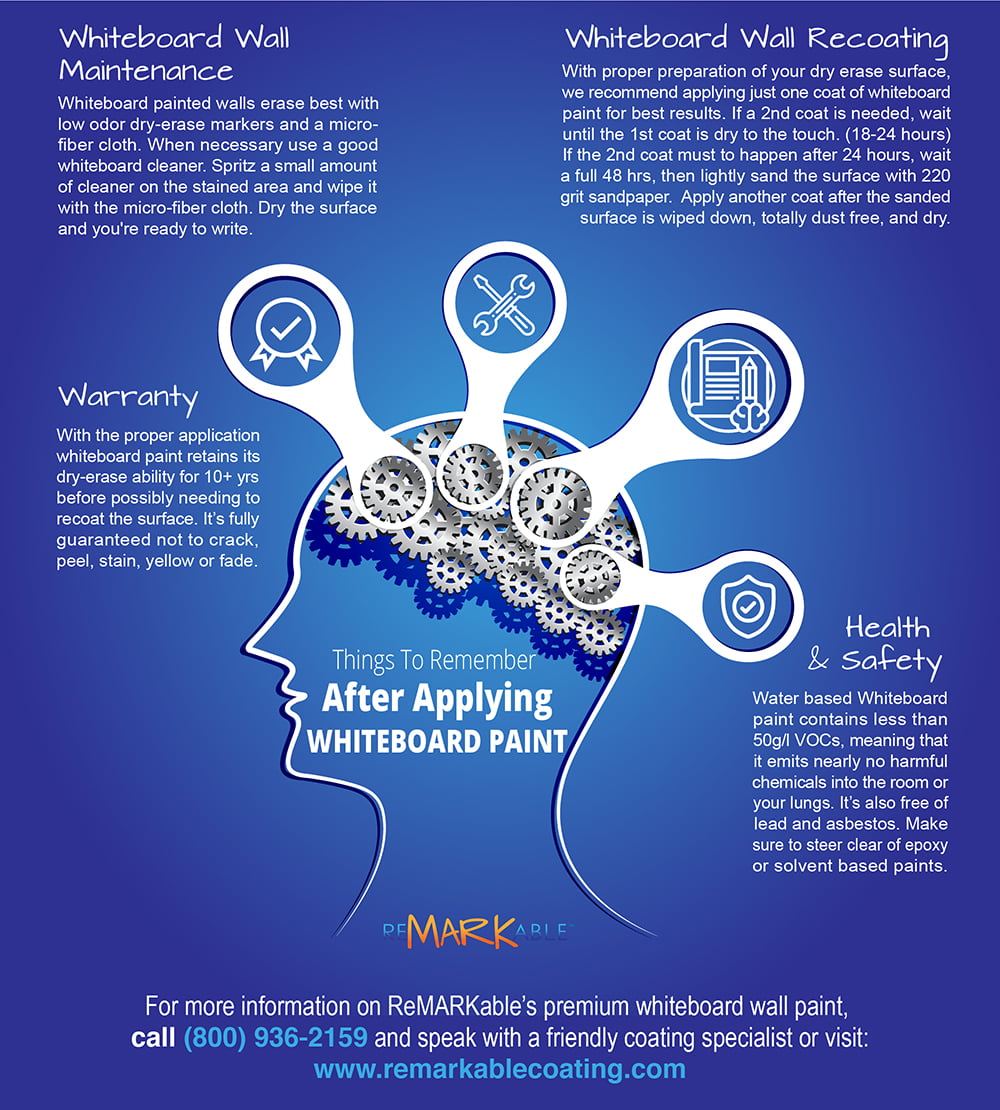
The high-VOC content of many epoxy-based whiteboard paints violates LEED standards. In contrast, ReMARKable is a LEED-compliant whiteboard paint because it contains 0.5% or less of VOCs. This feature makes the coating safe for use in any space where people spend a lot of time, such as a private home, business office, or school classroom.
“Off-gassing” is the process by which gases escape into the air while paints or coatings are drying. And if strong odors are emitted during this time, it’s a red flag indicating the presence of potentially harmful VOCs, as in the case of epoxy-based whiteboard paints. ReMARKable has a virtually odorless formulation, so off-gassing is not an issue. Also, besides being a non-toxic type of whiteboard paint, it has a short 48-hour curing time. This allows students, household members, or others to resume their normal activities after the coating is installed quickly.
C. Additives to Avoid in Whiteboard Paint
When exploring the safety of whiteboard paint for your home or classroom, you should avoid products containing antimicrobial additives and other harsh chemicals. Antimicrobials are chemical compounds added to a wide range of products for the purpose of killing microorganisms and minimizing the spread of infections. They destroy bacteria, viruses, protozoa, and fungi to lengthen a product’s lifespan, reduce stain- and odor-causing microbes in finishes, and prevent microbe accumulation on surfaces.
While antimicrobials may be of benefit in terms of hygiene, that fact doesn’t balance out their damaging impact on human and environmental health. Antimicrobials can irritate the skin, disrupt hormone balance, cause reproductive problems, suppress the immune system, and even cause cancer. Besides, the VOCs released by antimicrobial coatings can contribute to poor indoor air quality, which is harmful to occupants. ReMARKable Whiteboard Paint is free from antimicrobials, so it’s safe to apply even in spaces frequented by children or people with respiratory issues.
Is Whiteboard Paint Safe for Schools and Classrooms?
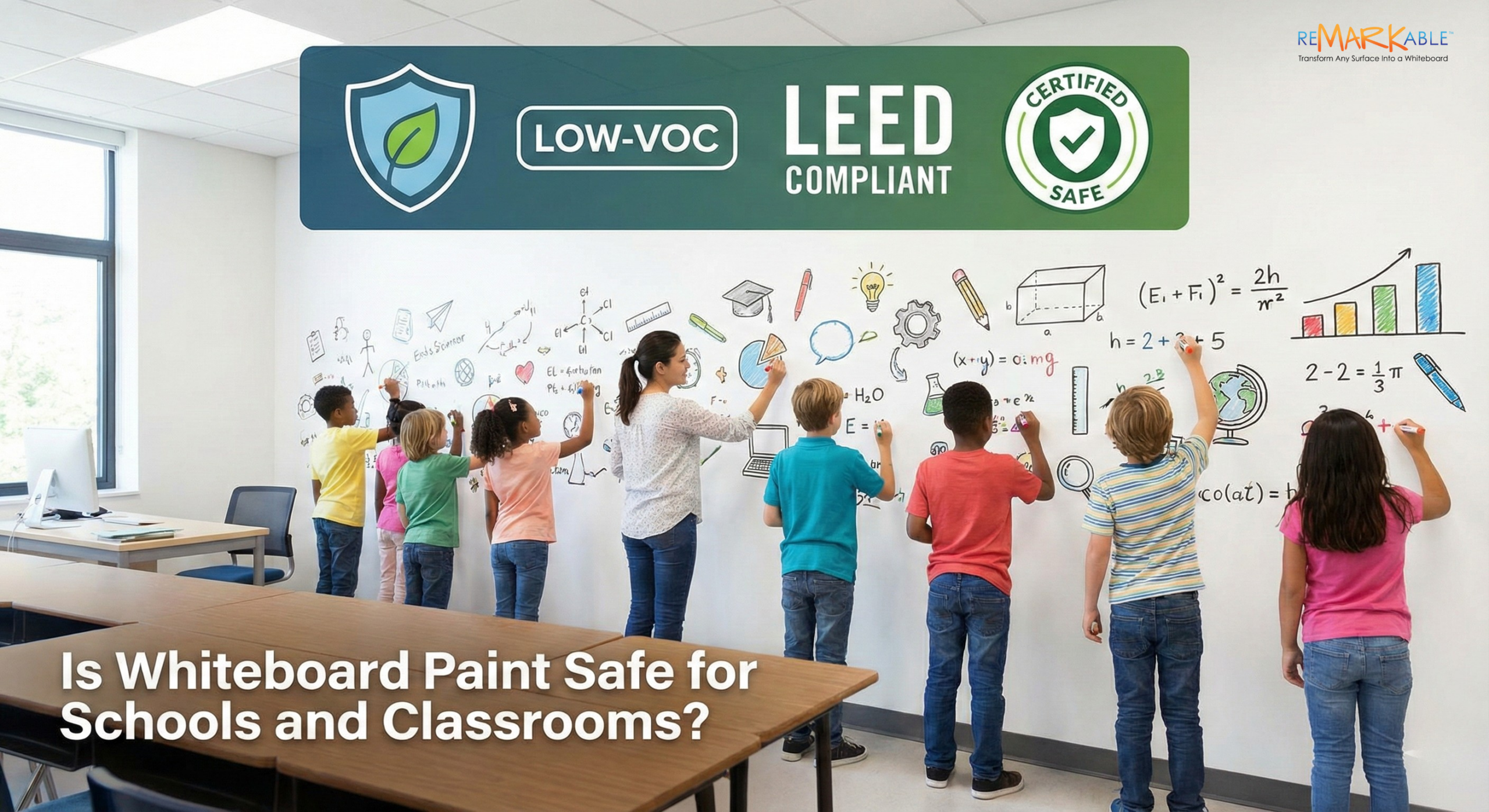
Educators, school administrators, building managers, architects, and others involved in working with academic institutions can rest assured that premium whiteboard paint is safe to use in educational settings. Here are some of the reasons:
• The coating is certified safe for environments where children are present.
• It’s odorless and extremely low in VOC content.
• It’s suitable for daily use during classes and other school activities.
• It has a highly eco-friendly, non-polluting LEED-compliant formulation.
• It possesses long-term durability (less replacement = safer environments).
These qualities make low-VOC, LEED-compliant whiteboard paints a reliable choice for educational environments.
Is Whiteboard Paint Safe for Homes and Home Offices?
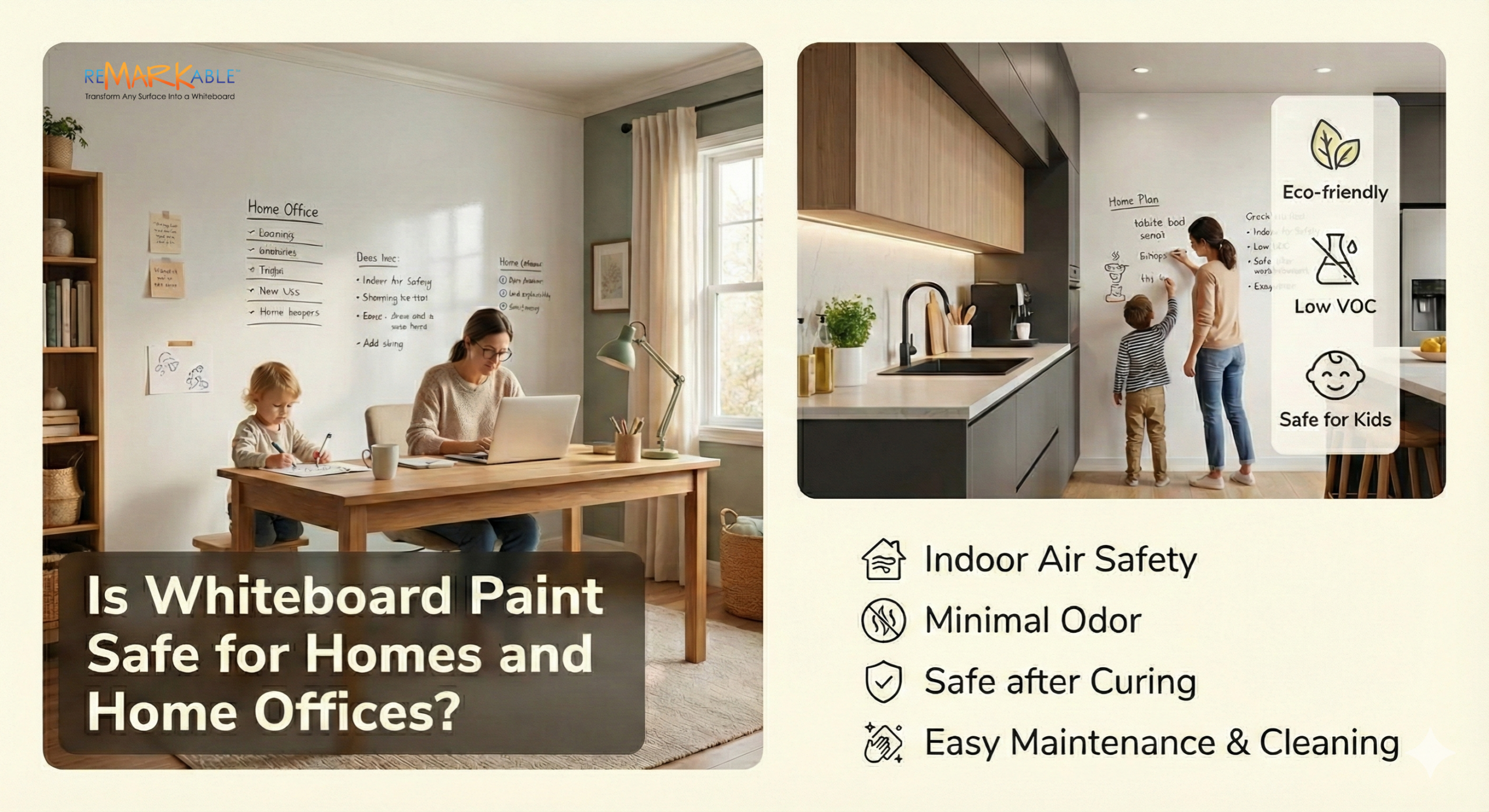
Owners who wish to enhance their homes with Whiteboard Paint can consider the following points before choosing the product:
• Indoor air safety – The formulation’s unsurpassed quality keeps air clean and breathable.
• Minimal odor – Extremely low VOC content makes for a non-hazardous, virtually odor-free interior environment.
• Safe after curing – Short curing time and lack of off-gassing during and after application keep the coated writing surface and surroundings safe.
• Easy maintenance and cleaning – Cleaning with a microfiber cloth and water or an eco-friendly cleaner creates no indoor air pollution.
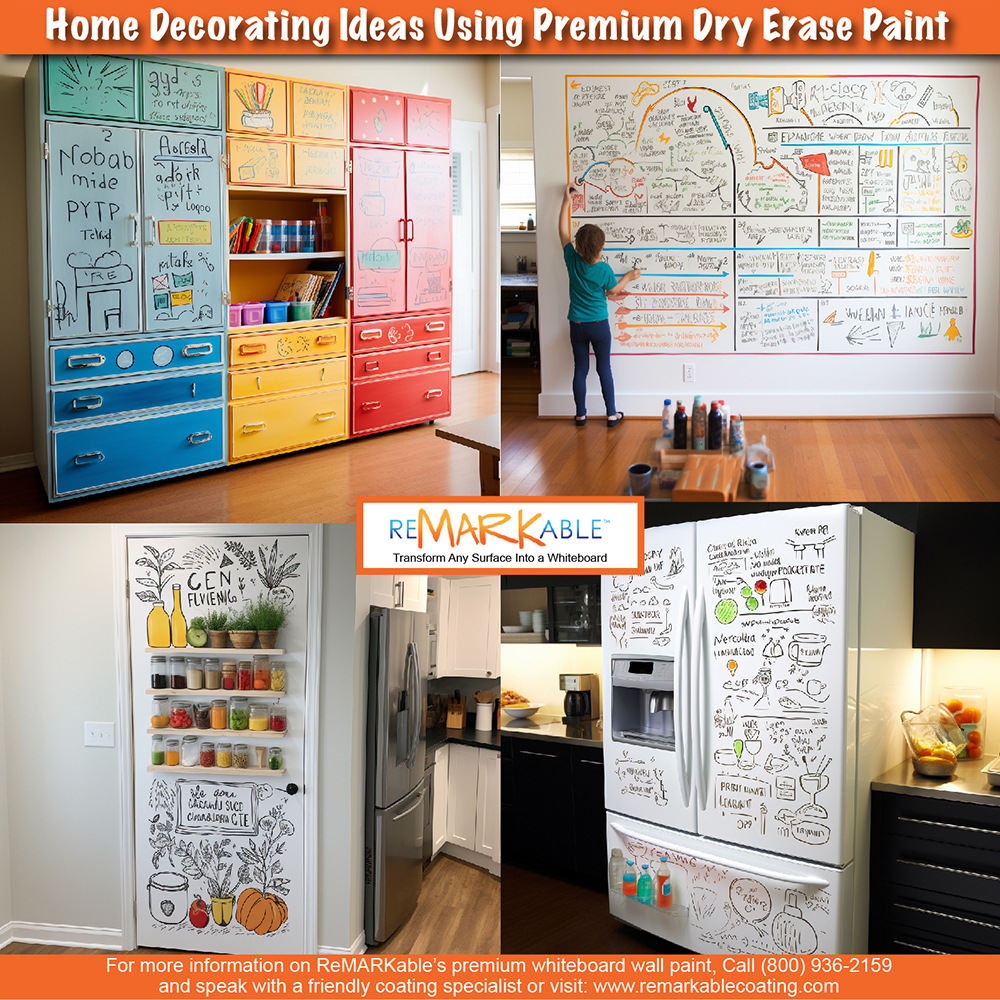
In light of these facts, you can feel confident that applying whiteboard paint for kids and other family members is safe and practical. Bedrooms, playrooms, kitchens, home offices, and other areas can thus become instant communication hubs.
How ReMARKable Whiteboard Paint Meets Safety Standards
Its advanced chemical formulation, stringent manufacturing standards, and intensive, multi-stage quality control process make premium whiteboard paint 100% safe for use in schools. It’s also harmless for application in private residences.
As mentioned above, ReMARKable Whiteboard Paint is compliant with the stringent safety guidelines of Leadership in Energy and Environmental Design (LEED). Specifically, the product contains less than 0.5 milligrams per cubic meter of VOCs. This makes it nontoxic, virtually odor-free, and certified safe for schools and children.
With its highly resilient composition, the coating is designed for long-term interior use. This fact is backed up by ReMARKable’s ten-year guarantee against yellowing, peeling, and cracking.
Proper Application and Ventilation for a Safe Finish
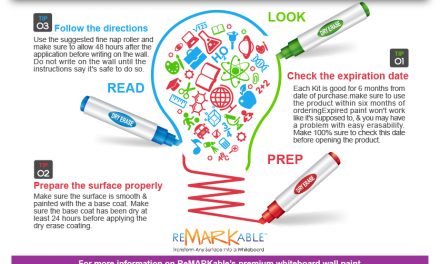
Proper preparation of your surface affects the safety and performance of whiteboard paint. For example, if an inappropriate base coat is applied under the top coat, adverse chemical reactions may occur. These could lead to the emission of VOCs that would not normally occur if a proper base coat were used.
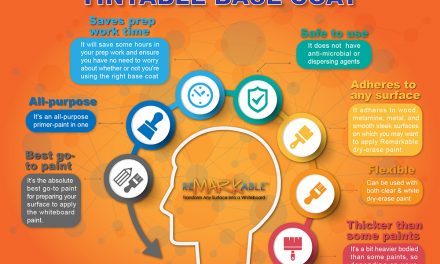
The safest, most trouble-free undercoat to install is ReMARKable Tintable Base Paint, which is a primer and base paint in one. Thus, it eliminates the need to apply separate products. Adequate ventilation of your space is also a key element in a safe and successful installation. The company’s US-based technical support team can provide you with all the information you need to ensure your whiteboard paint is safely installed and results in a flawless finish.
Whiteboard paint for classrooms and homes should be allowed a curing time of 48 hours (see Whiteboard Paint Prep Definitive Guide). In contrast, most other whiteboard paints require three to seven days to cure due to their high VOC content. As mentioned, these chemicals used in manufacturing many whiteboard paints can keep being discharged into the air for many years after application.
Take the Next Step in Choosing a Safe Whiteboard Paint
Choosing a safe whiteboard paint starts with understanding indoor air quality, certifications, and proper application. If you have questions about selecting a product for your home or school, ReMARKable’s technical support team is available to help.



![Giant Leaps Forward Require Big Spaces. [Leap Year Sale Event!]](https://www.remarkablecoating.com/wp-content/uploads/2016/02/Giant-Leaps-ForwardRequire-Big-Spaces-440x264.jpg)



![30% Off St Patrick’s Day Sale! [Details Inside]](https://www.remarkablecoating.com/wp-content/uploads/2016/03/Glorious-1-440x264.png)

![Drive Your Organization Into Openness and Watch it Expand [20% Off Whiteboard Paint]](https://www.remarkablecoating.com/wp-content/uploads/2016/04/Drive-Your-Organization-Into-Openness-and-Watch-It-Expand.-1-440x264.jpg)

















![ReMARKable’s Winter Sale is Here! [25% Off + Free Shipping]](https://www.remarkablecoating.com/wp-content/uploads/2018/01/Red-Tag-Winter-Fashion-Facebook-Post-1-440x264.png)


![ReMARKable Summer Sale 2018 [28% Off Whiteboard Paint]](https://www.remarkablecoating.com/wp-content/uploads/2018/06/Blue-Simple-Line-Beach-Facebook-Post-1-440x264.png)




















































































































































































































0 Comments