
Why Whiteboard Painted Walls Are a Teacher’s Ultimate Sanctuary
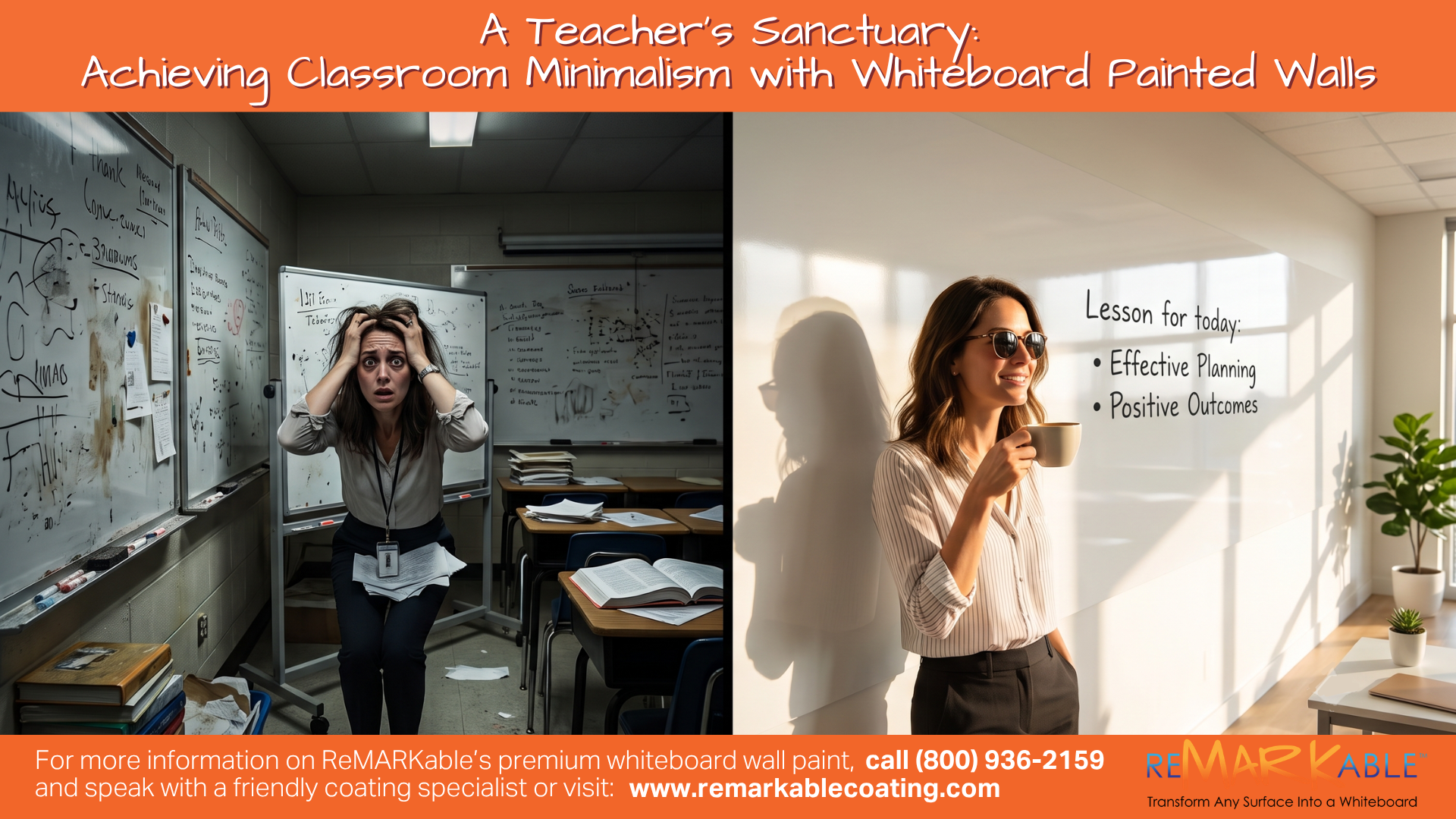
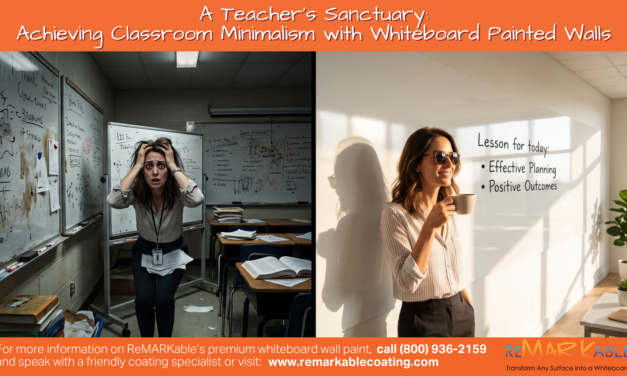
Step into your classroom on the first morning of the new school year, and imagine being greeted by the serene, sunlit expanse of seamless whiteboard painted walls rather than a chaotic patchwork of industrial hardware and clutter. For educators returning to campus after a much-needed summer break, the physical environment of the classroom sets the immediate emotional tone for the entire academic year. While traditional classroom discussions often center exclusively on student metrics, a critical truth remains: the classroom is a teacher’s workplace, their second home, and their primary space for professional output. When that environment is overwhelmed by bulky metal whiteboard frames, protruding chalk trays, overlapping paper posters, and space-consuming mobile boards, it creates a constant background hum of visual noise. Achieving true classroom minimalism through invisible infrastructure is not about creating a cold, sterile room; it is about stripping away industrial friction to cultivate a calm, breathable sanctuary where both educator and student can thrive.
1. The Toll of Visual Clutter: Why Whiteboard Walls Beat Industrial Hardware
Every educator is familiar with the creeping sense of fatigue that settles in by the final bell of the school day. While lesson delivery and student management account for much of this exhaustion, environmental psychology reveals that visual clutter is a massive, silent contributor to cognitive overload. In a standard classroom, the walls are frequently a battleground of conflicting visual stimuli. Notice boards compete with taped-up charts, while heavy aluminum borders frame stained, aging dry-erase boards.
The Psychology of Visual Cognitive Load
The human brain processes visual information continuously, even when we are not consciously focusing on our surroundings. Every hanging object, mismatched border, and bulky piece of classroom hardware demands a micro-fraction of subconscious attention. Over the course of a seven-hour teaching day, navigating this fragmented visual landscape forces the brain to work overtime just to filter out the noise. This phenomenon—known as sensory fatigue—directly elevates stress hormones, accelerates end-of-day burnout, and leaves teachers feeling mentally drained before grading even begins.
Replacing Industrial Hardware with Serene Surfaces
To reclaim mental bandwidth, progressive educators are turning to the principles of minimalist design. By removing clunky, wall-mounted hardware and utilizing sleek whiteboard walls, teachers can instantly quiet the visual acoustics of their rooms. When bare drywall is transformed into a functional writing surface, the distracting visual borders disappear entirely. The room suddenly feels cohesive, deliberate, and restful. Instead of feeling trapped in an industrial institution, teachers gain a calm, orderly environment that actively supports emotional regulation and sustained focus throughout the busiest school days.
2. Invisible Infrastructure: Designing Minimalist Rooms with Whiteboard Paint
In high-end architectural and interior design, the concept of “invisible infrastructure” refers to essential functional tools that blend so seamlessly into the environment that they become virtually unnoticeable when not in active use. When applied to educational spaces, this philosophy completely reimagines how a classroom should look and operate.
Functionality That Disappears on Demand
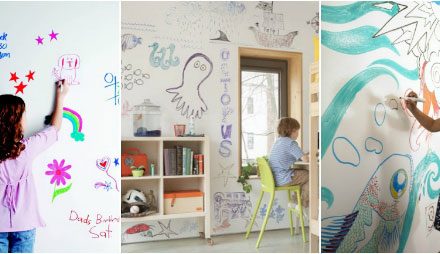
Traditional classroom tools are loud and intrusive. A standard framed whiteboard or a bulky rolling chart stand occupies physical and visual space 24 hours a day, seven days a week, whether a teacher is writing on it or not. It dominates the room’s aesthetic. Conversely, whiteboard paint allows administrators and teachers to integrate writing utility directly into the architecture of the building itself. When a lesson is in progress, the wall serves as an expansive, high-performance display of ideas, diagrams, and daily schedules. But the moment the marker ink is wiped away with a microfiber cloth, the utility disappears. What remains is simply a clean, glossy, professionally finished wall that reflects light and enhances the room’s spaciousness.
Removing the Physical Barriers to Calm
By replacing fixed, framed equipment with seamless dry erase walls, teachers eliminate the jarring physical boundaries that chop up a room’s visual flow. There are no sharp metal corners to navigate around, no dusty chalk trays catching sleeves, and no dark, stained borders framing the room’s primary focal point. This frameless approach allows the architecture to breathe. It provides educators with the comforting assurance that their tools are always ready when inspiration strikes, yet completely out of the way when the mind requires quiet space and simplicity.
3. Reclaiming Classroom Floor Space with Seamless Whiteboard Painted Walls
In almost every school building, square footage is at a strict premium. Teachers spend hours before the start of each school year arranging and rearranging student desks, reading rugs, bookshelves, and teacher stations, trying to maximize pathways and safety. However, traditional classroom equipment often acts as an stubborn obstacle to optimal room layout.
Eliminating Spatial Roadblocks
Consider the footprint of a standard mobile whiteboard on casters or a large easel stand. These items consume square feet of valuable floor space, blocking natural walking pathways between desks and forcing teachers to press their furniture into cramped, uncomfortable configurations. Even wall-mounted boards create spatial limitations; because protruding trays and bulky frames extend outward from the drywall, bookshelves and storage cabinets cannot be placed flush against the wall, resulting in wasted inches and awkward gaps that collect dust.
Vertical Freedom Without the Footprint
When an institution invests in durable whiteboard painted walls, the need for space-consuming mobile boards evaporates entirely. The entire vertical surface of the room becomes available for instructional use without sacrificing a single square inch of floor space.
- Seamless Alignment: Storage units, student desks, and cozy reading chairs can be positioned cleanly against the wall without interfering with bulky frames or trays.
- Unobstructed Movement: Teachers can circulate smoothly through the classroom, offering individual student guidance without bumping into rolling chart stands or navigating narrow aisles.
- Open Layouts: The physical footprint of the room expands, making small or awkwardly shaped classrooms feel immediately larger, more accessible, and far more welcoming.
4. Designing a Sunlit Sanctuary: How Dry Erase Walls Enhance Light and Calm
The first day of school is synonymous with fresh beginnings. Walking into a pristine, sunlit classroom that feels open and airy inspires a sense of professional pride and renewed energy. Achieving this coveted atmosphere requires careful attention to how natural light and surface finishes interact within the space.
Maximizing Natural Sunlight Without Glare
Many older whiteboards—particularly low-quality melamine or heavily worn porcelain—either absorb too much light, making the front of the room look dim and dingy, or produce a harsh, blinding glare under overhead fluorescent bulbs. Premium dry erase walls, when professionally applied over smooth drywall, offer a balanced, subtle sheen that beautifully bounces natural sunlight across the room. As morning light streams through campus windows, it catches the clean, frameless surfaces, illuminating dark corners and creating a bright, uplifting ambiance that artificial lighting cannot replicate.
Creating Dedicated Zones for Mental Reset
In a minimalist classroom, every space serves a clear, intentional purpose without unnecessary visual overlap. With frameless writing surfaces, teachers can easily zone their rooms to protect their personal mental well-being:
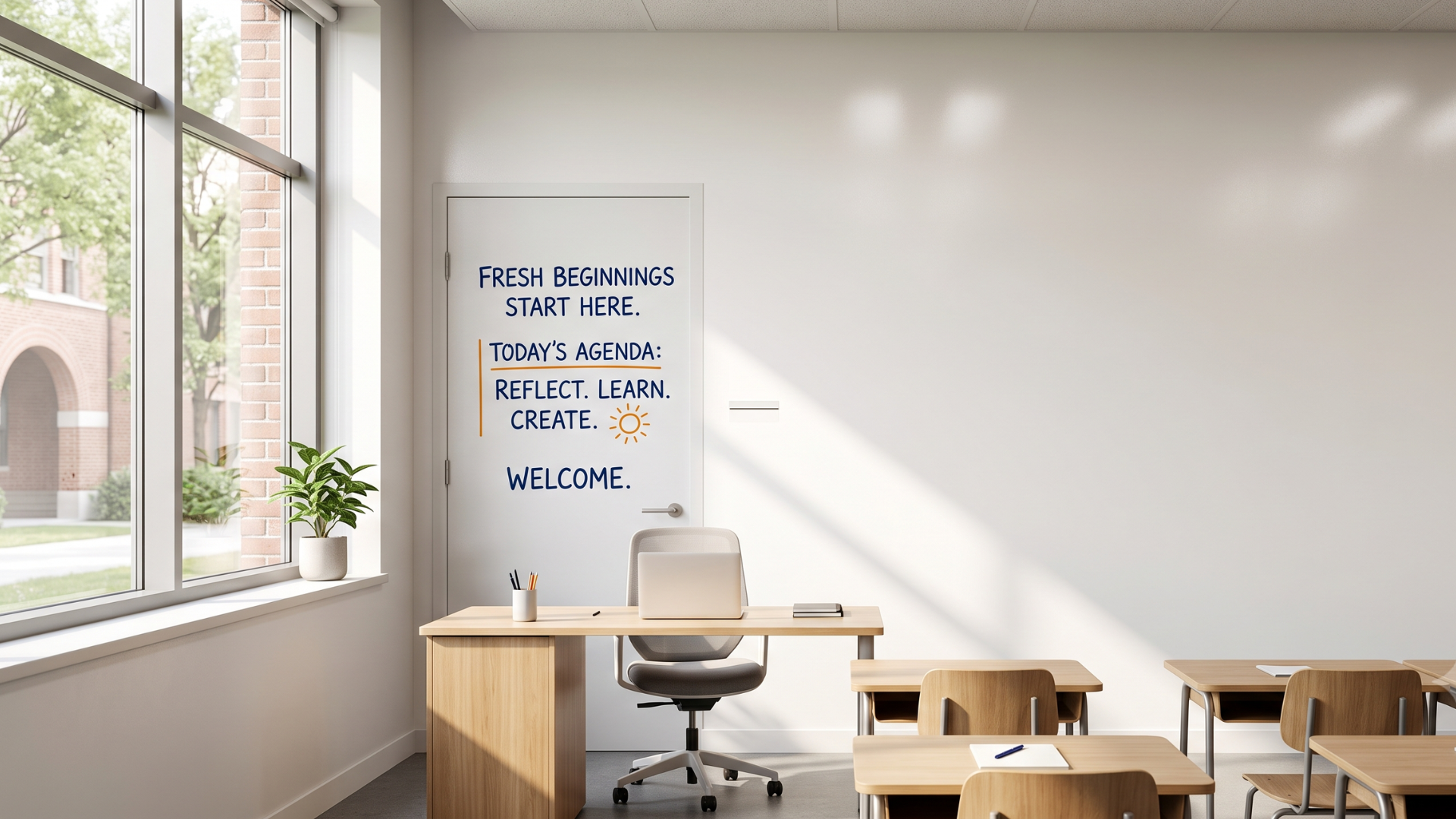
- The Morning Slate: A clean, frameless section near the door dedicated solely to a welcoming quote and the day’s simple agenda, setting a calm, predictable tone as students arrive.
- The Teacher’s Scratchpad: A discreet vertical space near the teacher’s desk coated with whiteboard wall paint, replacing cluttered desk sticky notes and sprawling paper to-do lists with a single, easily erasable organization hub.
- The Sensory Reset Zone: A blank, unwritten expanse of wall intentionally left clear to give the eyes and mind a place to rest during quiet reading time or independent study.
The 3:00 PM Ritual of Release
There is a distinct psychological satisfaction in the daily ritual of resetting a classroom. With traditional framed boards, cleaning is often a frustrating chore involving chemical sprays to remove ghosting from decaying edges. With seamless whiteboard paint, the end-of-day cleanup becomes a meditative act of closure. As the educator wipes the broad, frameless expanse clean with a cloth, they are visually and symbolically erasing the stress, noise, and chaos of the school day. Leaving behind a spotless, glowing wall ensures that when the teacher unlocks the door the following morning, they are greeted by a serene, immaculate sanctuary ready for a brand-new day.
5. Practical Minimalism: A Teacher’s Guide to Using Whiteboard Wall Paint
Transitioning from a traditional, high-clutter classroom to a streamlined sanctuary of calm does not happen by accident; it requires an intentional audit of your teaching tools and a willingness to let go of outdated visual habits. As you prepare your room for the upcoming academic year, consider this structured approach to classroom decluttering using high-performance whiteboard wall paint.
Step 1: The Visual Audit
Stand in the center of your classroom and scan the perimeter from left to right. Ask yourself:
- How many separate framed items are currently hanging on my walls?
- Do these items serve an active, daily instructional purpose, or have they become permanent visual wallpaper?
- How much physical floor space is currently blocked by storage carts, chart stands, or rolling boards?
Step 2: Stripping the Industrial Layers
Begin by removing the items that create unnecessary borders and visual noise. Take down aging, non-essential posters, eliminate frayed decorative borders around bulletin boards, and work with your campus facility manager to evaluate removing old, ghosted wall whiteboards. When you strip away these layered distractions, you reveal the clean, architectural lines of the room beneath.
Step 3: Upgrading to Permanent, Frameless Utility
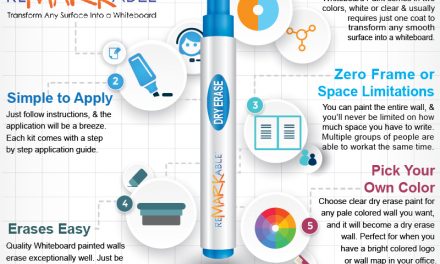
Rather than replacing old hardware with adhesive dry-erase sheets that peel, bubble, and yellow over time, advocate for a permanent infrastructure upgrade using high-quality dry erase walls. By applying whiteboard wall paint directly onto prepped drywall, you eliminate the need to ever shop for, mount, or replace classroom boards again. This one-time investment permanently frees you from the cycle of managing deteriorating hardware, allowing you to focus your energy entirely on creative teaching and personal well-being.
6. The Long-Term Professional Benefits of a Decluttered Teaching Environment
The impact of classroom minimalism extends far beyond aesthetics; it fundamentally alters the educator’s daily professional experience. When a teacher is supported by an environment that prioritizes calm, organization, and visual breathing room, the downstream benefits are profound.
|
Traditional Cluttered Classroom
|
The Minimalist Frameless Sanctuary
|
|
High Cognitive Load: Constant visual noise from overlapping posters, metal frames, and cluttered borders drains mental energy.
|
Mental Clarity: Clean, frameless walls provide visual rest, preserving cognitive bandwidth for instruction and patience.
|
|
Restricted Movement: Protruding trays and bulky mobile easels block pathways and force cramped furniture layouts.
|
Spatial Freedom: Zero-footprint wall utility opens up floor plans, enabling seamless movement and flexible desk configurations.
|
|
Frustrating Maintenance: Ghosted melamine and dusty chalk trays require harsh chemical solvents and tedious scrubbing.
|
Meditation Reset: Effortless wiping on smooth, non-porous surfaces provides an instant, satisfying end-of-day closure.
|
|
Industrial Atmosphere: Feels like a sterile, institutional facility designed purely for storage and standardized compliance.
|
Welcoming Second Home: Feels like a bright, sunlit, modern studio designed to inspire creativity, peace, and professional pride.
|
When schools prioritize the mental health and daily comfort of their teaching staff by modernizing room environments, teacher retention and morale naturally rise. A decluttered, beautifully illuminated room communicates a powerful message of institutional respect: it tells the educator that their workspace is valued, their mental well-being is prioritized, and their professional dignity is protected.
Step Into a Calmer School Year
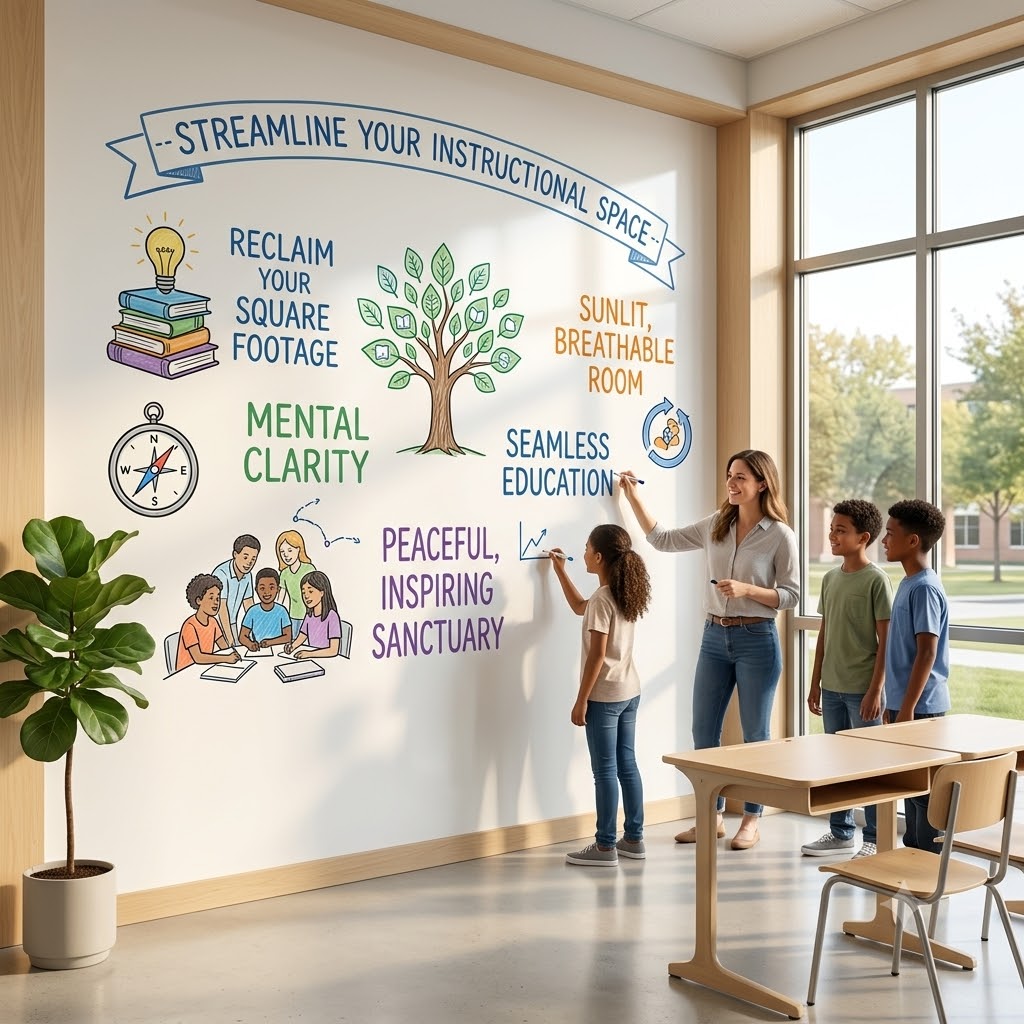
Ultimately, choosing to streamline your instructional space by installing whiteboard painted walls is far more than a functional facility upgrade; it is an intentional commitment to preserving your mental clarity and daily peace of mind. As you step into the 2026-2027 school year, you deserve an environment that revitalizes your passion for teaching rather than draining your energy with visual chaos and industrial clutter. By stripping away clunky metal frames, protruding chalk trays, and space-consuming mobile stands, you reclaim precious physical square footage and create a sunlit, breathable room that feels open, organized, and profoundly calm. When we use premium whiteboard paint to create invisible infrastructure, we allow the tools of education to blend seamlessly into the architecture, appearing when needed and vanishing into clean, light-reflecting surfaces the moment the lesson ends. Whether you are transforming a cozy reading nook, modernizing your personal desk organization, or upgrading an entire campus building, prioritizing frameless whiteboard walls ensures that your room functions as a true home away from home. By embracing the elegance and simplicity of a seamless dry erase wall, you can finally transform your classroom into the peaceful, inspiring sanctuary that both you and your students deserve. This confirms that the most liberating foundation for a successful school year is, and will always be, your whiteboard painted walls.



![Giant Leaps Forward Require Big Spaces. [Leap Year Sale Event!]](https://www.remarkablecoating.com/wp-content/uploads/2016/02/Giant-Leaps-ForwardRequire-Big-Spaces-440x264.jpg)



![30% Off St Patrick’s Day Sale! [Details Inside]](https://www.remarkablecoating.com/wp-content/uploads/2016/03/Glorious-1-440x264.png)

![Drive Your Organization Into Openness and Watch it Expand [20% Off Whiteboard Paint]](https://www.remarkablecoating.com/wp-content/uploads/2016/04/Drive-Your-Organization-Into-Openness-and-Watch-It-Expand.-1-440x264.jpg)

















![ReMARKable’s Winter Sale is Here! [25% Off + Free Shipping]](https://www.remarkablecoating.com/wp-content/uploads/2018/01/Red-Tag-Winter-Fashion-Facebook-Post-1-440x264.png)




![ReMARKable Summer Sale 2018 [28% Off Whiteboard Paint]](https://www.remarkablecoating.com/wp-content/uploads/2018/06/Blue-Simple-Line-Beach-Facebook-Post-1-440x264.png)











































































































































































































































































0 Comments