
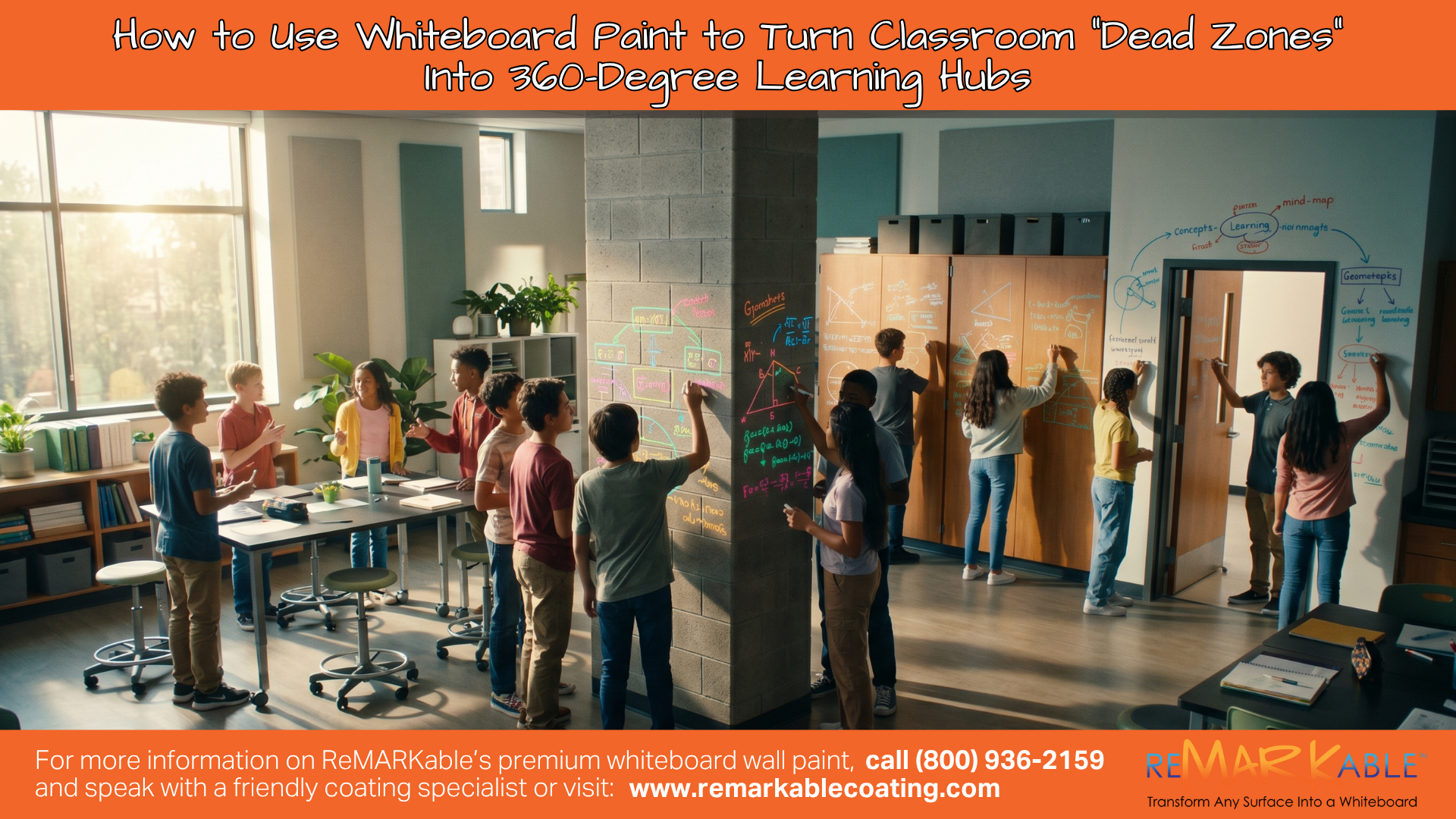
How to Use Whiteboard Paint to Turn Classroom “Dead Zones” Into 360-Degree Learning Hubs
As educators and administrators prepare for the back-to-school season, the most transformative architectural upgrade a school can invest in isn’t a fleet of expensive new smart tablets—it’s a simple gallon of whiteboard paint. Every August, facilities managers, principals, and teachers dedicate countless hours to arranging desks, scrubbing linoleum floors, and stapling fresh contact paper to bulletin boards. But in the race to prep the physical classroom, we routinely overlook the most powerful asset in the building: the passive, vertical real estate of the room itself.
Traditional classroom design suffers from a major pedagogical bottleneck known as the “front-of-the-room bias.” When 100% of the actionable writing space is trapped on a single eight-foot board mounted behind the teacher’s desk, student engagement operates on a steep downward slope. The further back a child sits, the more passive their learning experience becomes.
To build a truly collaborative, 21st-century educational environment, schools need to stop viewing classroom walls as rigid boundaries and start treating them as 360-degree canvases. By identifying and transforming the awkward, ignored “dead zones” of your school building, you can decentralize the classroom and turn passive onlookers into active, standing problem-solvers.
The Bottleneck: Why the “Front Board” is Failing Modern Pedagogy
For over a century, the standard classroom geometry hasn’t budged: rows of students facing a singular focal point. However, modern curriculum standards—from K-12 STEM initiatives to university breakout seminars—demand kinetic, peer-to-peer collaboration.
When four students are told to work through a complex geometry proof together, squeezing their thoughts onto an 8.5×11-inch piece of scrap paper forces three of them to become mere spectators. Furthermore, standard framed whiteboards come with severe physical limitations for school districts:
- The Cost-Per-Foot Trap: High-end commercial whiteboards with aluminum frames cost exorbitantly per square foot, eating up department budgets.
- The Mounting Hazard: Hanging heavy, 50-pound porcelain boards in cinderblock or aging drywall requires heavy-duty masonry anchors, creating permanent structural damage and safety liabilities.
- The “Frame Boundary”: Aluminum borders dictate where an idea has to stop. If a student runs out of room during a long division problem, the thought gets erased rather than expanded.
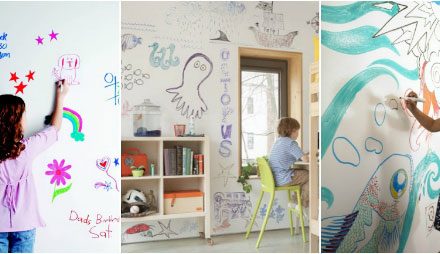
By utilizing commercial-grade dry erase paint, facilities teams can bypass the bracket-and-bolt dilemma entirely. You can turn virtually any non-porous architectural element into an edge-to-edge writable surface, wrapping ideas right around the room.
The Classroom “Dead Zone” Audit
Walk into any standard classroom, stand in the center, and look past the primary whiteboard. You are looking for the “dead zones”—sturdy, vertical surfaces that currently serve zero academic function, but consume vast amounts of visual space.
In the average school building, these dead zones include:
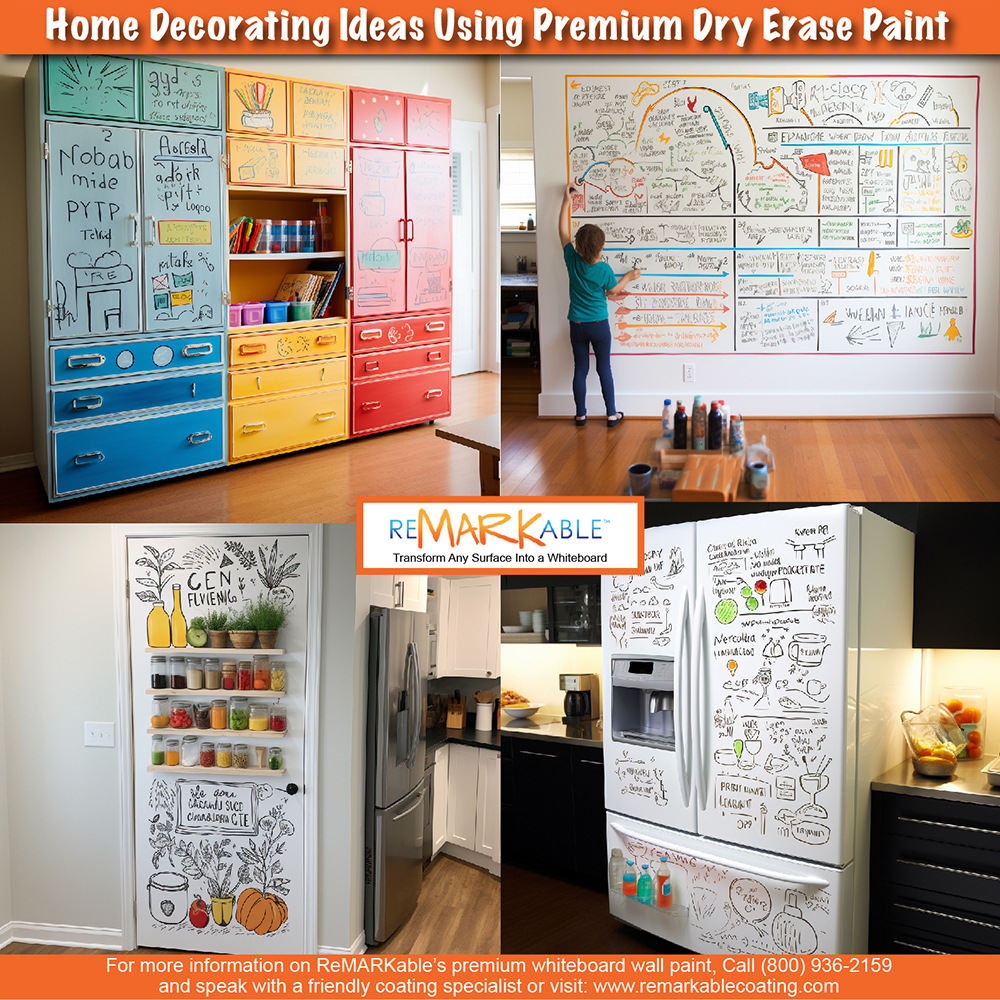
- The wide, flat wooden faces of floor-to-ceiling teacher storage wardrobes.
- The masonry load-bearing pillars that sit awkwardly between classroom windows.
- The solid wood or metal entry doors leading out to the hallway.
- The low exterior side panels of rolling AV carts, book bins, and teacher desks.
- The “in-between” hallway wall space situated directly between classroom doorways.
Transforming these five areas shifts the classroom from a lecture hall into an active laboratory. Here is how to deploy them for the upcoming semester.
1. The Storage Monolith: Turning Laminated Cabinets into “Thinking Stations”
Almost every standard classroom built after 1970 features a massive, faux-wood laminate storage cabinet sitting in the corner. It holds extra reams of paper, tissue boxes, and old textbooks. It is visually heavy, dark, and entirely dead.
Coating the doors of these storage units with dry erase paint turns a six-foot monolith into a primary student workstation.
How Teachers Use It:
- The Anonymous “Parking Lot”: Many students have high anxiety about raising their hand to say, “I don’t understand.” Designate the left cabinet door as the “Parking Lot.” Students can walk up at any point during a transition and jot down an anonymous question about the lesson. The teacher can address the board during the final ten minutes of class.
- The “Exit Ticket” Checkpoint: Positioned near the door, the cabinet becomes the ultimate formative assessment tool. As students line up for lunch or the bell, they must solve the single math problem or define the vocabulary word written on the cabinet door to “buy” their exit.
- Station Rotations: During guided reading or math centers, the cabinet door serves as “Station 3,” where four students stand together to dissect a sentence diagram without fighting for table space.
2. The Masonry Pillar: The “Vertical Non-Permanent Surface” (VNPS)
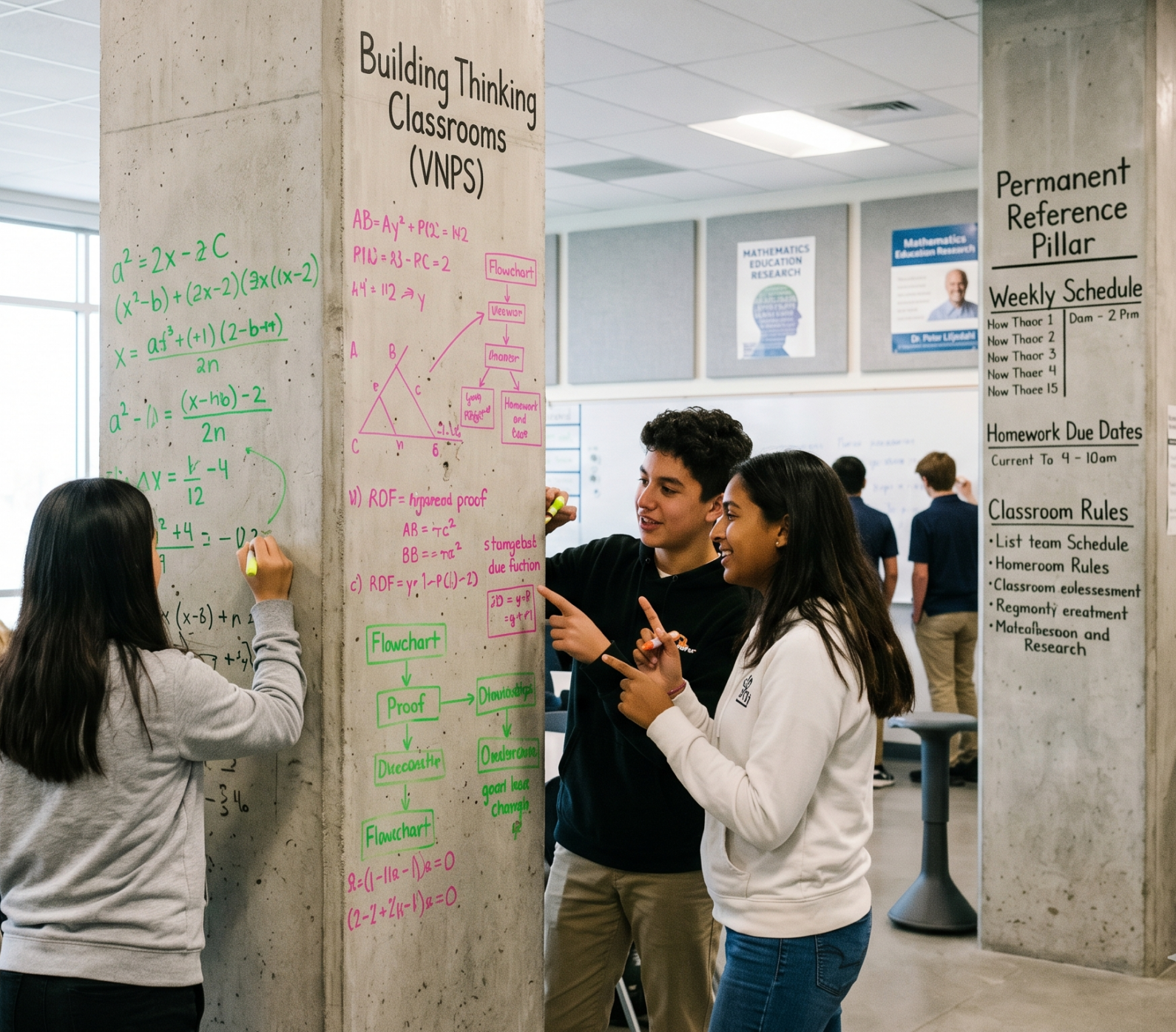
In modern mathematics instruction, there is a massive pedagogical movement spurred by Dr. Peter Liljedahl’s research called Building Thinking Classrooms. The core tenet is that students think best when standing up, working in randomized groups of three, on Vertical Non-Permanent Surfaces (VNPS).
The psychology is fascinating: when a student writes on paper, they view it as an official, permanent record. Therefore, they are terrified of making a mistake and freezing up. When they write on a wipeable whiteboard wall, the perceived risk of failure drops to zero. If a theory is wrong, a quick swipe of the palm makes it vanish.
How Teachers Use It:
- De-escalating Math Anxiety: Assign the narrow masonry pillars between the windows to groups of three. Give them a single dry-erase marker (forcing them to talk to one another to agree on what gets written down).
- The “Permanent” Reference Pillar: Teachers often complain that writing class schedules, homework due dates, or classroom rules on the main front board takes up space they need for teaching. Dedicating a side pillar strictly to “Admin Data” keeps the main board clear for active instruction.
3. The Low Flanks: Activating Primary & Inclusive Zones
When adults design classrooms, we suffer from an eye-level bias. We forget that a first grader’s eye level is three-and-a-half feet off the ground, and that a student in a wheelchair navigates the room on a totally different vertical plane.
Look at the sides of the heavy teacher’s desk facing the room, the wooden ends of communal activity tables, or the low space beneath the chalkboard ledges. Coating these low surfaces with dry erase formula creates an instantly accessible, highly inclusive learning zone.
How Teachers Use It:
- Sight-Word Scrambles (K-2): Lower elementary students have an innate biological need to sit on the floor. Putting a writable strip two feet off the ground allows them to sit cross-legged on the rug and practice letter formation at their natural height.
- The Desk-Side Leaderboard: For middle schoolers participating in gamified learning (such as a “Classroom Economy” or a reading race), the side panel of the teacher’s desk can hold the running tally, turning an ugly gray steel panel into a point of pride.
4. The Hallway Spillover: The “Glass Bowl” Effect
In high schools and university settings, the hallway right outside the classroom door is treated purely as a transit corridor. But overcrowded schools need to view the hallway as an instructional pressure-relief valve.
By applying clear dry-erase topcoats over the existing painted cinderblock outside the door, you create a “spillover zone.”
How Teachers Use It:
- The Peer Tutoring Nook: When a small group of advanced students finishes a project early, sending them out to the hallway whiteboard painted walls to work on an extension activity gets them out of the room, lowering the decibel level for the students still testing inside.
- The “Public Defense” Wall: High school AP science classes can post their research hypotheses in the hallway, inviting students and faculty from other classes to leave notes, peer reviews, or counter-arguments as they walk by between periods.
The Facilities Director’s ROI: Paint vs. Porcelain
While teachers love the pedagogical freedom of a 360-degree classroom, district buyers and school boards look at the bottom line. Ripping out old chalkboards and buying custom-sized whiteboards to fit between a classroom’s thermostat, intercom speaker, and fire alarm is a nightmare of custom ordering.
The Fiscal Case for Coating:
- Zero Custom Fabrication: A gallon of commercial dry erase coating doesn’t care where the intercom button is. You simply use standard painter’s tape to frame the thermostat, light switches, and fire strobe, maximizing every square inch of the awkward drywall.
- No Down-Time for Asbestos Testing: In pre-1980 school buildings, drilling into old classroom walls to hang heavy whiteboard brackets often triggers mandatory, expensive asbestos disturbance testing. Painting right over the existing encapsulated masonry bypasses this red tape entirely.
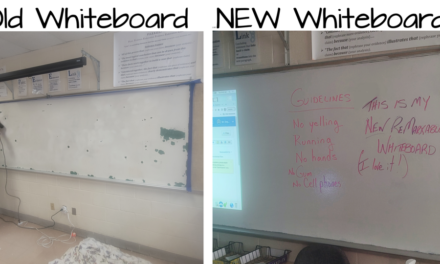
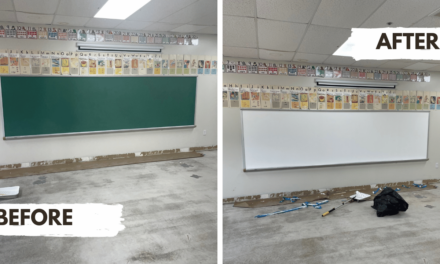
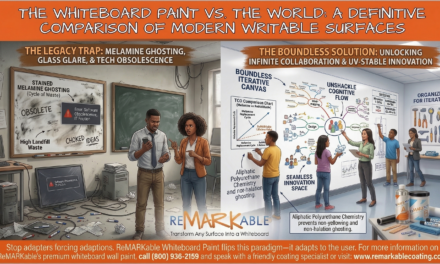
- The “Ghosting” Fix: Old, cheap classroom whiteboards eventually suffer from “ghosting”—a state where the surface becomes so porous that dry erase marker permanently stains it a muddy gray. Rather than throwing those 4×8 boards into a local landfill, maintenance teams can roll a fresh coat of high-grade white dry-erase paint directly over the dead board, restoring it to a factory-grade sheen for a fraction of replacement cost.
The Back-to-School “Weekend Blitz” Protocol
Because modern, premium dry-erase formulas feature rapid cure times and low-VOC (Volatile Organic Compound) emissions, a school district’s summer maintenance crew can execute an entire wing’s “dead zone transformation” in a single weekend without leaving lingering chemical odors for the Monday morning bell.
- Friday (The Prep): The custodial staff wipes down the classroom doors, laminated storage cabinets, and target cinderblock pillars with a standard degreaser. Tape off the targeted zones.
- Saturday (The Roll): Maintenance rolls out the two-part formula. Because commercial coatings are self-leveling, they go on smoothly over both wood grain and primed drywall.
- Sunday (The Cure): The rooms sit locked and dark, allowing the molecular cross-linking of the paint to harden into an impermeable, glass-like shell.
- Monday Morning: The blue tape is pulled. The teacher walks into a room that feels twice as big, completely unburdened by the front-of-the-room bottleneck.
Empowering the Standing Student
When we force students to sit in static plastic chairs for seven hours a day, staring at a single rectangle on a distant wall, we shouldn’t be surprised when their attention wanders. Movement is the spark that ignites cognition.
As your school district finalizes its back-to-school budgets this year, look past the catalog of expensive smart-boards and look at the bare wood, metal, and drywall surrounding your students. By unlocking the dormant power of your building’s architecture with premium whiteboard paint, you aren’t just buying a school supply—you are giving your students the literal room they need to stand up, step forward, and think.



![Giant Leaps Forward Require Big Spaces. [Leap Year Sale Event!]](https://www.remarkablecoating.com/wp-content/uploads/2016/02/Giant-Leaps-ForwardRequire-Big-Spaces-440x264.jpg)



![30% Off St Patrick’s Day Sale! [Details Inside]](https://www.remarkablecoating.com/wp-content/uploads/2016/03/Glorious-1-440x264.png)

![Drive Your Organization Into Openness and Watch it Expand [20% Off Whiteboard Paint]](https://www.remarkablecoating.com/wp-content/uploads/2016/04/Drive-Your-Organization-Into-Openness-and-Watch-It-Expand.-1-440x264.jpg)
















![ReMARKable’s Winter Sale is Here! [25% Off + Free Shipping]](https://www.remarkablecoating.com/wp-content/uploads/2018/01/Red-Tag-Winter-Fashion-Facebook-Post-1-440x264.png)



![ReMARKable Summer Sale 2018 [28% Off Whiteboard Paint]](https://www.remarkablecoating.com/wp-content/uploads/2018/06/Blue-Simple-Line-Beach-Facebook-Post-1-440x264.png)

























































































































































































0 Comments