

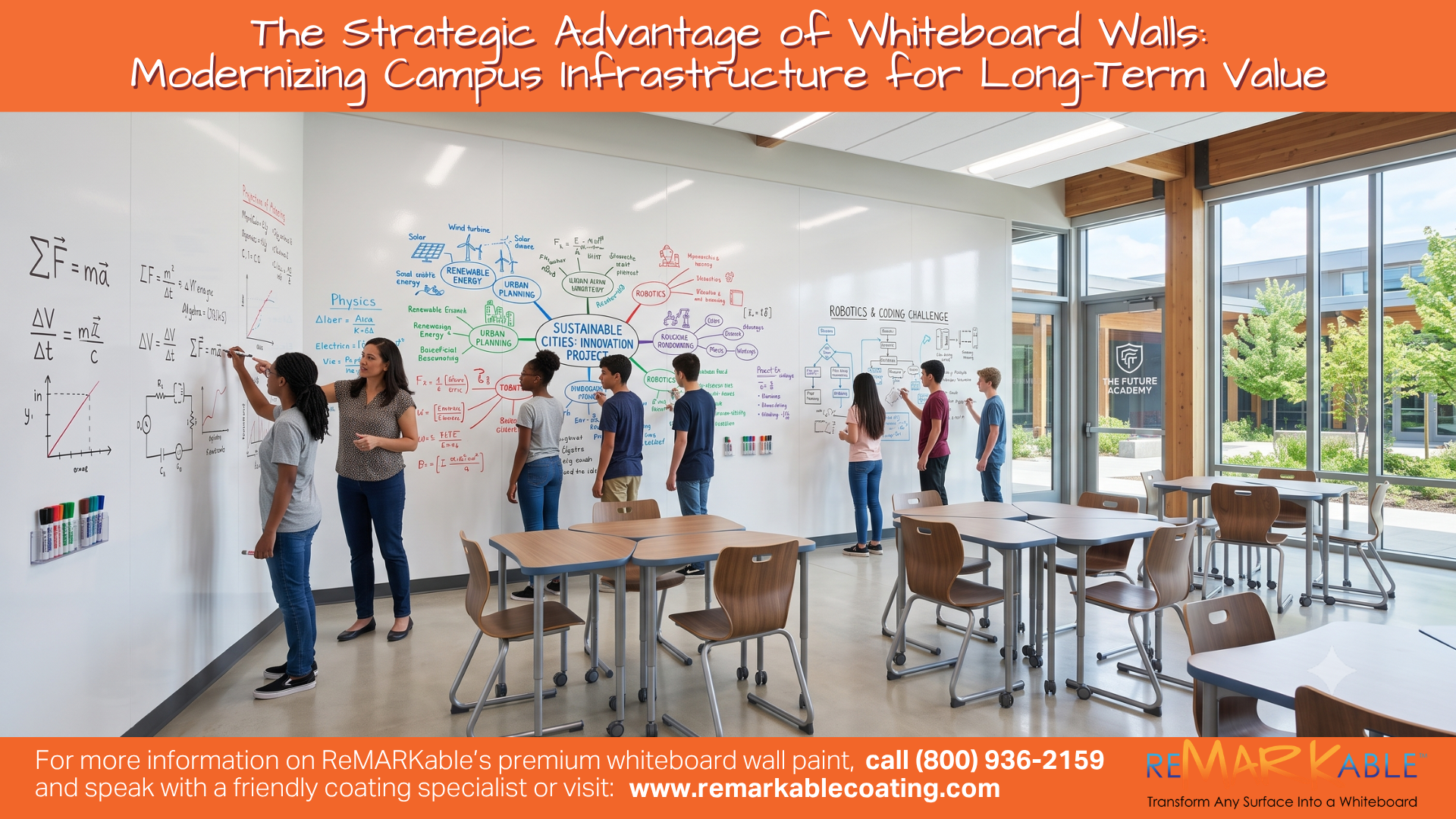
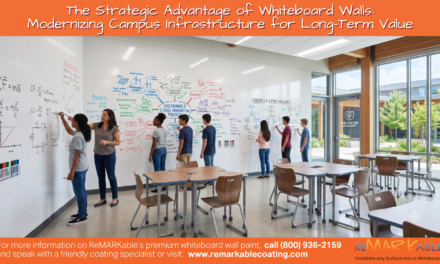
Whiteboard Walls: Modernizing Campus Infrastructure for Long-Term Value
When evaluating capital improvements and facility upgrades, progressive school administrators are increasingly discovering that installing whiteboard walls is one of the most cost-effective ways to transform an outdated campus into a dynamic, future-ready educational environment. For school owners and institutional leaders, the challenge has always been balancing fiscal responsibility with the imperative to provide cutting-edge learning spaces. The physical environment directly dictates pedagogical success, and moving away from traditional, restrictive dry-erase boards toward seamless, writable surfaces represents a monumental leap forward in campus management, instructional design, and long-term asset optimization.
1. The Hidden Costs of Traditional Classroom Hardware
For decades, the standard classroom setup has relied on framed whiteboards or chalkboards bolted directly to masonry or drywall. While these traditional boards seem like a familiar baseline requirement, they carry a host of hidden operational costs that accumulate over a building’s lifecycle, draining maintenance budgets and wasting custodial resources.
The Maintenance Deficit
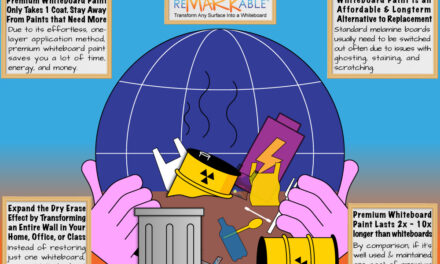
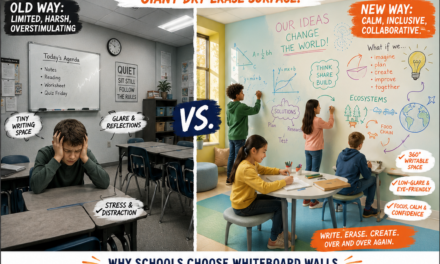
Traditional framed boards are notoriously prone to rapid surface degradation. Within three to five years of daily classroom use, standard melamine and porcelain surfaces begin to experience “ghosting”—the permanent residue left by dry-erase markers that refuses to wipe clean. Once this occurs, custodial staff spend excessive hours applying harsh chemical solvents to restore the surface. This aggressive cleaning cycle only strips the remaining protective coating, creating a porous surface that absorbs marker ink even faster and accelerating the board’s decline into an unreadable mess.
Infrastructure Damage and Replacement Expense
When a traditional wall-mounted board fails, replacing it sets off a costly chain reaction of labor and facility downtime that requires:
- Custodial and Maintenance Labor: Teams must dismount heavy hardware, navigate hallways, and pay commercial disposal fees to dump bulky non-recyclable materials into landfills.
- Facilities Repair and Restoration: Maintenance personnel must patch heavy anchor holes, repair torn drywall tape, and repaint large wall sections where old frames trapped years of dirt and grime.
- Capital Expenditure and Shipping: Administrators must continuously allocate capital to purchase and ship new, fragile framed boards that are frequently dented or shattered in transit.
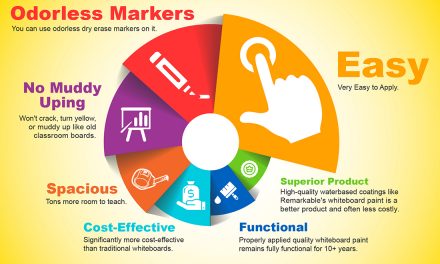
By utilizing high-performance whiteboard paint, administrators permanently eliminate this wasteful cycle of hardware replacement. Transforming standard bare drywall into seamless whiteboard painted walls converts an architectural necessity—the classroom wall itself—into a permanent instructional asset that requires zero mounting hardware, never needs to be unbolted, and eliminates continuous equipment disposal.
2. Maximizing Square Footage Through Agile Room Design
In an era where educational facilities must accommodate expanding enrollments, varied collaborative curricula, and multi-purpose community programming, square footage is an institution’s most valuable physical asset. Limiting writable surfaces to a single rectangle at the front of the room severely constricts how a classroom functions and dictates a passive learning model.
Breaking the “Front of the Room” Paradigm
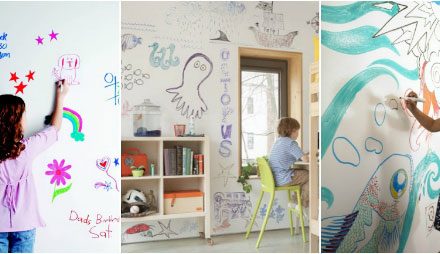
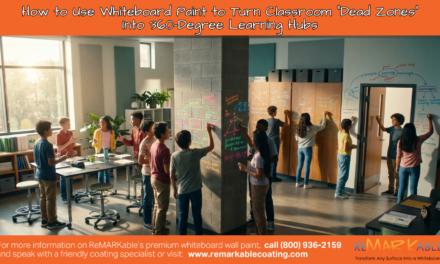
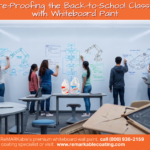
When schools apply premium whiteboard paint for classroom environments across entire walls, they effectively dismantle the traditional lecture-centric classroom layout. Teachers are no longer tethered to one static focal point at the head of the room. Instead, the entire perimeter of the learning space becomes an active instructional zone. This architectural agility allows a single classroom to transition smoothly between diverse instructional modes:
- Morning Core Academic Sessions: The wall serves as an expansive visual timeline for historical analysis, a mapping space for literary themes, or a canvas for architectural drafting.
- Mid-Day Collaborative Transitions: Small breakout groups utilize different sections of the room simultaneously to solve complex mathematical problems without competing for limited board space.
- After-School and Community Programming: The room effortlessly converts into an interactive tutoring center, an administrative faculty breakout space, or a community meeting room where group brainstorming flows naturally.
Eliminating Visual Clutter and Sensory Overload
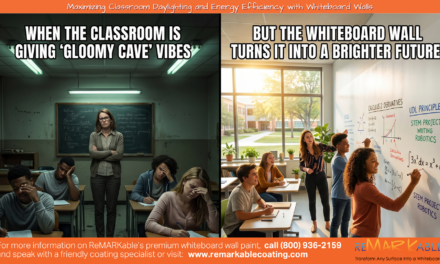
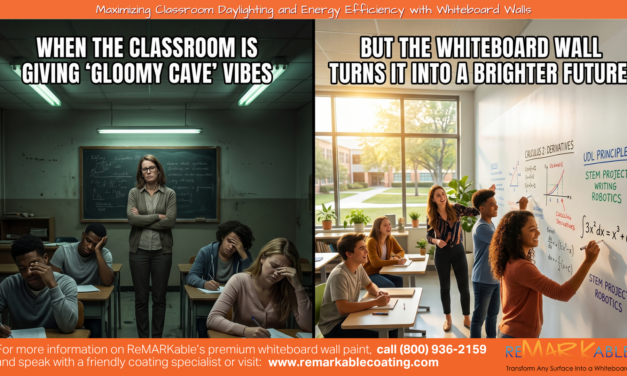
Modern interior design principles in educational settings emphasize clean lines, open spaces, and reduced visual noise—factors that research proves significantly improve student cognitive retention and focus. Dry erase walls integrate invisibly into the room’s overarching architectural aesthetic. When not actively in use for writing or drawing, they appear as clean, glossy, professionally finished walls, completely avoiding the industrial look of bulky metal frames, dusty chalk trays, and space-consuming mobile whiteboards that block pathways.
3. Fostering a 360-Degree Culture of Collaboration
The primary goal of modern educational leadership is to build active learning environments that adequately prepare students for the collaborative demands of the workforce. Achieving this institutional transformation requires physical tools that naturally invite participation, reduce academic anxiety, and democratize classroom engagement for every learner.
Increasing Student Agency and Participation
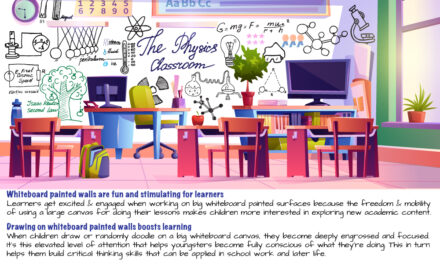
Psychological safety is a foundational prerequisite for deep exploratory learning. When students are called up to the front of the room to solve a problem on a traditional board while their peers watch from behind, the experience frequently induces debilitating performance anxiety. Conversely, when classrooms feature expansive whiteboard walls, collaboration becomes an immersive, decentralized activity. Students work side-by-side along the perimeter, sharing ideas in a low-stakes format where early mistakes can be wiped away instantly with the simple swipe of a cloth, encouraging experimentation and creative risk-taking.
Supporting Multi-Modal and Neuro-Inclusive Pedagogy
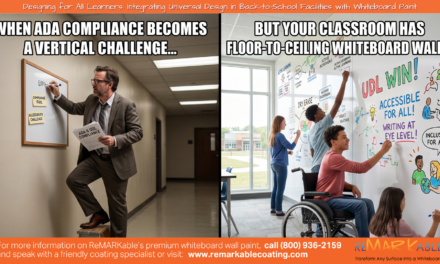
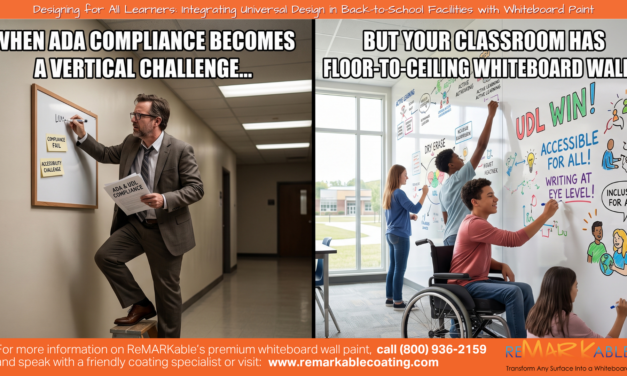
Universal Design for Learning (UDL) mandates that school administrators design academic environments that cater to a wide spectrum of cognitive, physical, and emotional needs. Expansive floor-to-ceiling writable surfaces provide distinct pedagogical advantages:
- Kinesthetic and Motor Engagement: Students who struggle with sedentary desk-based tasks or experience sensory overload thrive when given the freedom to stand, move, and use large gross-motor skills to sketch, write, and map concepts visually across a wall.
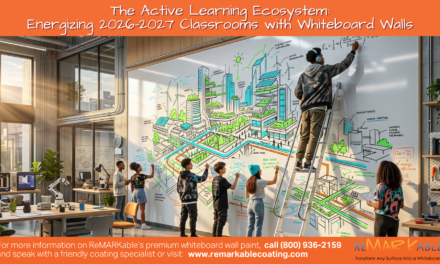
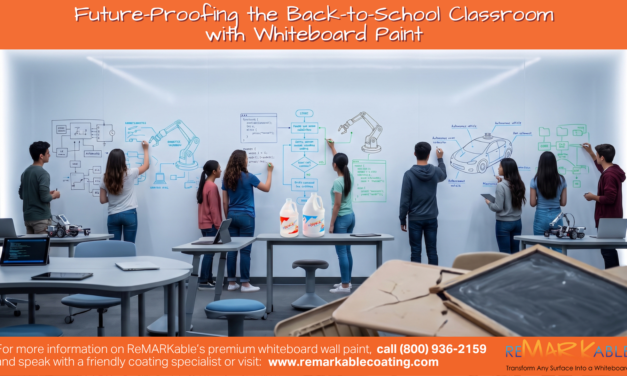
- Macro-Visual Mapping: Complex project-based learning and scientific inquiry require extensive spatial mapping that simply cannot fit within the tight confines of a standard board or tablet screen. Seamless walls allow students to visually connect disparate ideas across broad spaces.
- Decentralized Peer-to-Peer Instruction: Expansive surfaces allow teachers to step back from direct lecturing into a supportive, facilitative role while students actively demonstrate and explain foundational concepts to one another directly on the writable wall.
4. Long-Term Financial and Environmental ROI
For school owners, superintendents, and school board members, long-term fiscal sustainability is paramount when authorizing campus expenditures. Evaluating building materials and classroom furnishings through the rigorous lens of Total Cost of Ownership (TCO) reveals precisely why premium whiteboard paint is rapidly displacing traditional classroom equipment across forward-thinking institutions globally.
| Facility Metric | Traditional Framed Whiteboards | Premium Whiteboard Painted Walls |
| Average Functional Lifespan | 3 to 5 years before severe ghosting & staining | 10+ years with proper routine custodial maintenance |
| Capital Installation Cost | High (Requires specialized hardware & mounting) | Low (Applied directly to prepped drywall by painters) |
| Ongoing Maintenance Needs | Frequent chemical solvent cleaning & restoration | Simple wiping with standard non-toxic cleaners & cloths |
| Spatial Efficiency & Scale | Limited to rigid fixed dimensions (e.g., 4′ x 8′ panels) | Unlimited (Covers curved walls, columns, & full rooms) |
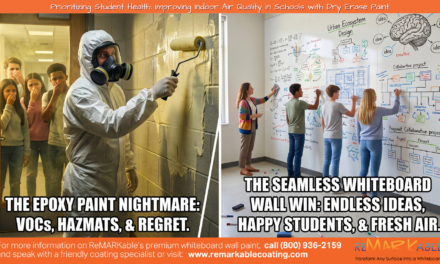
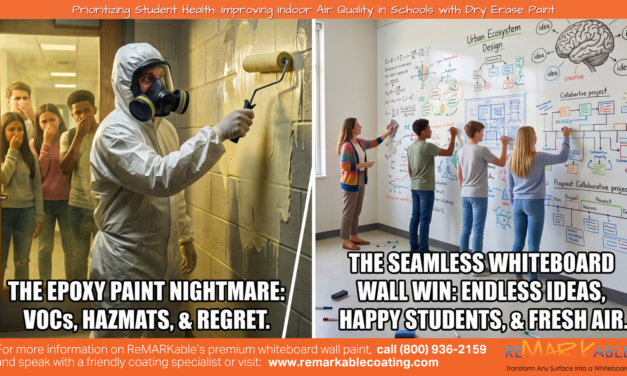
| Environmental Sustainability | High landfill waste (Non-recyclable plastics & metals) | Eco-friendly (Low-VOC coatings, zero hardware waste) |
Future-Proofing Campus Infrastructure
When an educational institution invests in professional-grade dry erase walls, it secures an ultra-durable commercial-grade surface specifically engineered to withstand the relentless daily wear and tear of K-12 and higher education environments. This inherent structural durability directly lowers annual operational maintenance budgets over a ten-year horizon. Custodial teams spend significantly less time scrubbing stubborn marker stains, and institutional procurement departments can permanently eliminate the recurring budget line item for replacement whiteboards and mounting hardware.
Enhancing Campus Marketability and Institutional Prestige
The aesthetic and functional quality of a school’s physical plant plays a pivotal role in recruiting prospective students, attracting and retaining elite faculty members, and securing community funding. Walking prospective parents, educational donors, and stakeholders through a campus equipped with sleek floor-to-ceiling whiteboard painted walls instantly communicates a tangible institutional commitment to pedagogical innovation, collaborative excellence, and forward-thinking architectural design. It transforms standard brick-and-mortar classrooms into a compelling visual showcase of institutional prestige and academic ambition.
5. Strategic Implementation: Best Practices for School Leaders
To maximize return on investment when upgrading campus facilities, administrators should implement a structured, phased rollout strategy that seamlessly aligns facility management protocols with overarching instructional goals.
Prioritize High-Impact Academic Zones
While wall-to-wall application across an entire school campus represents the ultimate infrastructure goal, phased facility implementations should strategically begin in high-impact academic zones:
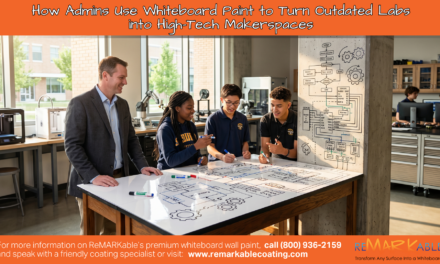
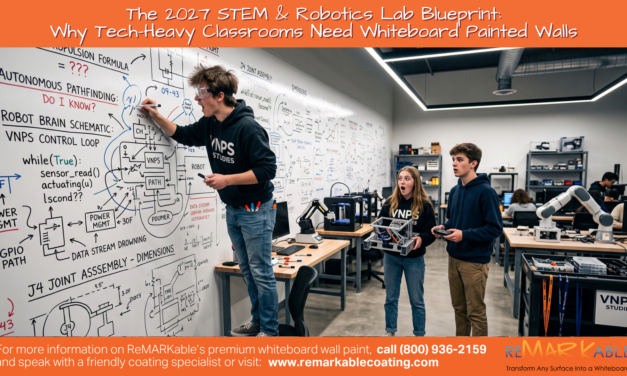
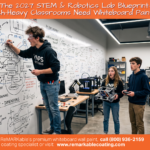
- STEM and Makerspace Laboratories: Where complex scientific formulation, engineering drafting, and rapid prototyping require massive visual real estate for collaborative team success.
- Library Breakout Rooms and Study Commons: To actively encourage informal group study, cross-disciplinary collaboration, and peer-led academic tutoring outside of standard classroom hours.
- Faculty Lounges and Departmental Conference Rooms: To streamline curriculum planning, administrative brainstorming, accreditation mapping, and professional development sessions for teaching staff.
Ensure Professional Surface Preparation
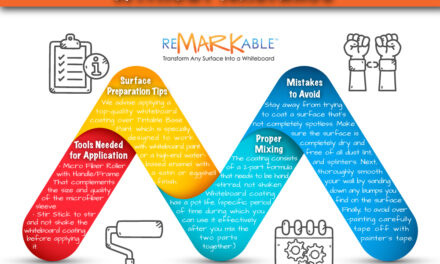
The long-term visual and erasing performance of whiteboard paint for classroom applications relies heavily on the physical smoothness and preparation of the underlying drywall substrate. Facilities maintenance teams or contracted commercial painters must adhere to strict preparation guidelines, ensuring that walls are meticulously patched, sanded to an ultra-smooth finish, and primed with high-quality compatible base coats prior to applying the specialized topcoat. A flawlessly smooth wall surface ensures effortless marker erasing and maximizes the coating’s protective, non-porous qualities for over a decade.
Establish Simple, Standardized Custodial Protocols
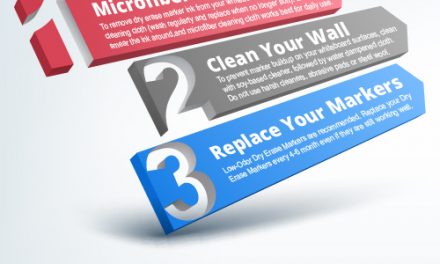
Protecting and preserving your campus facility investment requires clear, consistent communication with both teaching faculty and maintenance personnel. Providing classrooms with high-quality, low-odor dry-erase markers and microfiber towels ensures optimal surface longevity and clean erasing. Explicitly instructing custodial teams to avoid abrasive scouring pads or harsh chemical cleaners preserves the glossy high-performance sheen of the coated walls, ensuring they remain pristine and functional for ten years or more.
Conclusion
The decision to upgrade educational facilities by installing whiteboard painted walls extends far beyond mere aesthetic enhancement; it is a transformative pedagogical and operational strategy that reimagines how schools function. As educational institutions navigate the rapidly shifting demands of modern instruction, administrators must deploy adaptable building infrastructure that supports agile teaching methods, dramatically reduces long-term maintenance expenditures, and cultivates an inclusive, collaborative academic culture. By utilizing durable whiteboard paint, schools permanently eliminate the perpetual waste, physical damage, and recurring expense of framed hardware while simultaneously unlocking the full creative and intellectual potential of every classroom. Whether embarking on major new campus construction or executing targeted summer facility renovations, investing in seamless whiteboard painted walls ensures that your physical plant actively contributes to student engagement and academic excellence. Ultimately, transitioning to high-performance dry erase walls represents the ideal convergence of fiscal wisdom and instructional leadership, confirming that the most resilient, versatile, and inspiring canvas for student achievement will always be your whiteboard walls.



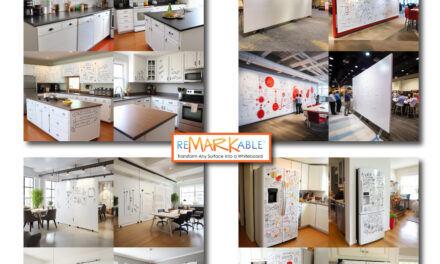
![Giant Leaps Forward Require Big Spaces. [Leap Year Sale Event!]](https://www.remarkablecoating.com/wp-content/uploads/2016/02/Giant-Leaps-ForwardRequire-Big-Spaces-440x264.jpg)



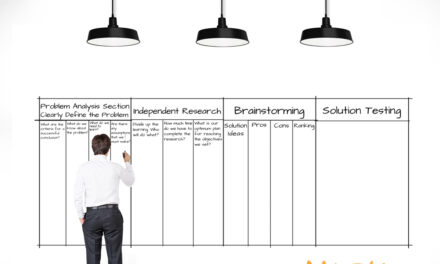
![30% Off St Patrick’s Day Sale! [Details Inside]](https://www.remarkablecoating.com/wp-content/uploads/2016/03/Glorious-1-440x264.png)

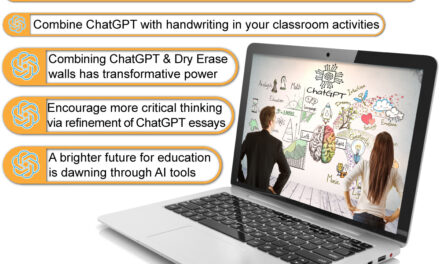
![Drive Your Organization Into Openness and Watch it Expand [20% Off Whiteboard Paint]](https://www.remarkablecoating.com/wp-content/uploads/2016/04/Drive-Your-Organization-Into-Openness-and-Watch-It-Expand.-1-440x264.jpg)
















![ReMARKable’s Winter Sale is Here! [25% Off + Free Shipping]](https://www.remarkablecoating.com/wp-content/uploads/2018/01/Red-Tag-Winter-Fashion-Facebook-Post-1-440x264.png)



![ReMARKable Summer Sale 2018 [28% Off Whiteboard Paint]](https://www.remarkablecoating.com/wp-content/uploads/2018/06/Blue-Simple-Line-Beach-Facebook-Post-1-440x264.png)










































































































































































0 Comments