

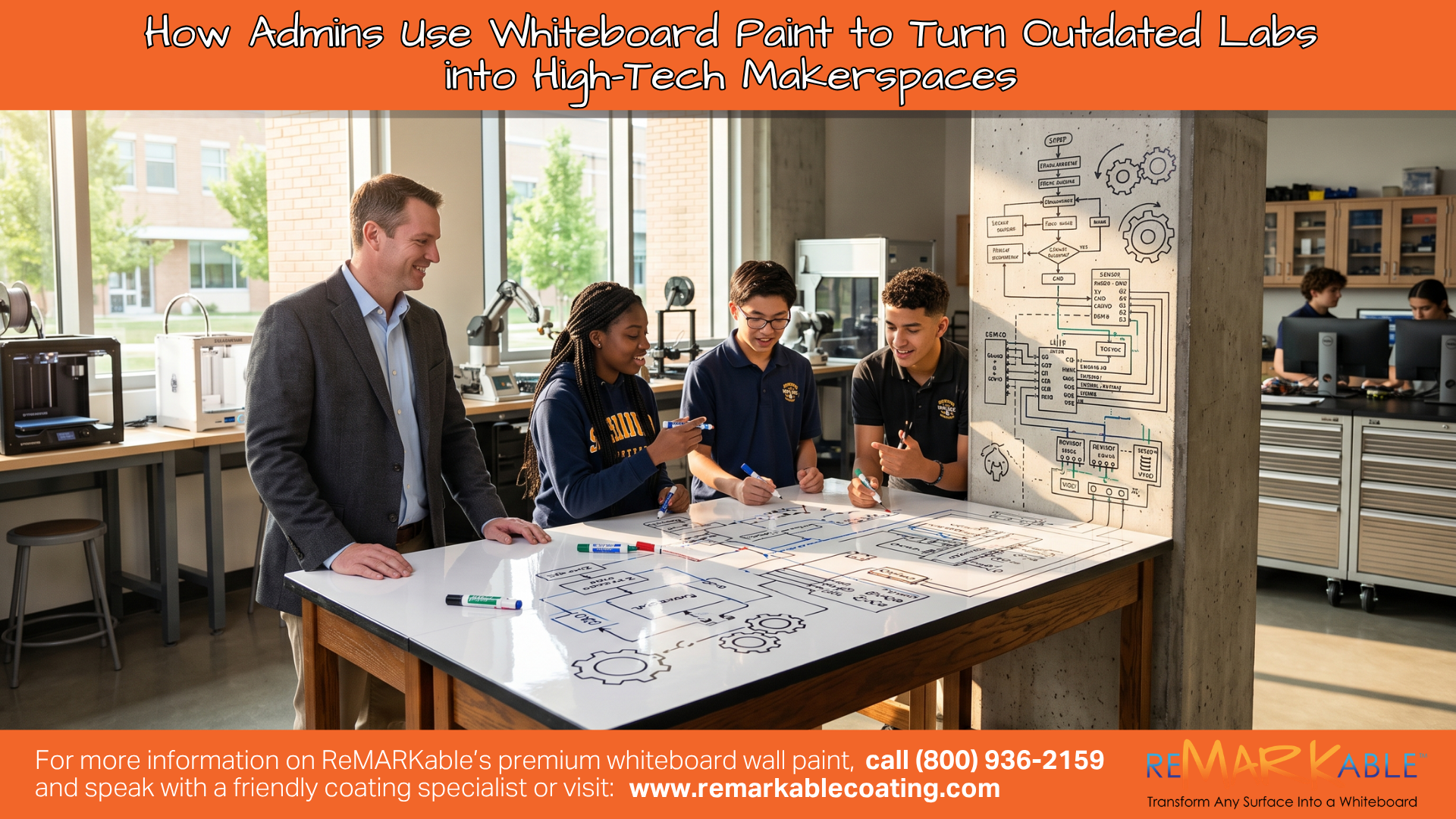
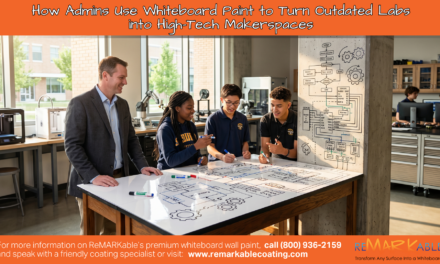
Using Whiteboard Paint to Turn Outdated Labs into High-Tech Makerspaces
For forward-thinking school administrators and facility directors, the secret to modernizing a campus on a strict summer budget begins with a single application of commercial-grade whiteboard paint. As the educational landscape accelerates toward the 2026–2027 academic year, private school owners, district superintendents, and campus planners face a persistent, high-stakes dilemma: how to continuously upgrade facilities to attract prospective students and retain top faculty without launching into multi-million-dollar structural renovations. Today, the “Makerspace”—a dedicated, flexible hub for STEM, robotics, coding, and creative problem-solving—is no longer an experimental K-12 luxury; it is a baseline enrollment necessity.
However, tearing down cinderblock walls, rerouting electrical infrastructure, and outfitting classrooms with custom architectural glass boards routinely drains the annual facilities budget before the summer painting window even opens. Enter the strategic, high-impact retrofit. By fundamentally rethinking how existing architectural planes are utilized, school leadership teams are systematically turning their most outdated real estate into their most compelling campus assets.
Rather than viewing legacy spaces as financial liabilities that require total demolition, modern educational leaders treat them as dormant canvases. Here is the comprehensive administrative blueprint for how top-tier institutions are deploying premium coatings to transform forgotten K-12 and university rooms into state-of-the-art innovation labs.
The Campus Tour “Wow” Factor: Selling the Collaborative Vision to Parents
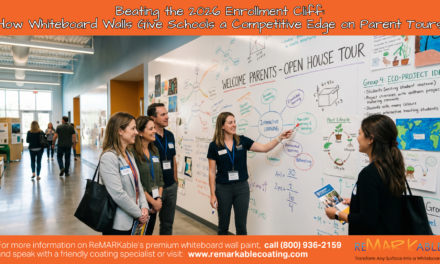
When prospective parents tour a campus, they are not just looking at test scores and matriculation lists; they are actively searching for visual cues that signal 21st-century pedagogical investment. An aging computer lab dominated by rows of bulky desktop monitors, fixed laminate partitions, and standard framed chalkboards instantly communicates “outdated methodology.” It tells parents that instruction is static, lecture-heavy, and tethered to the past.
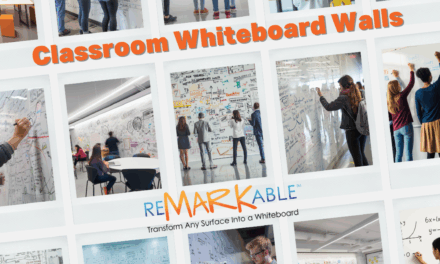
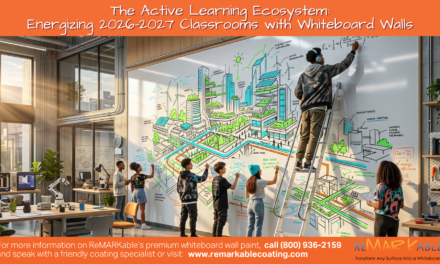
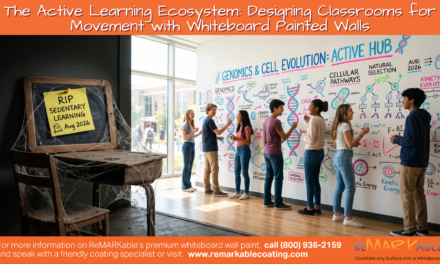
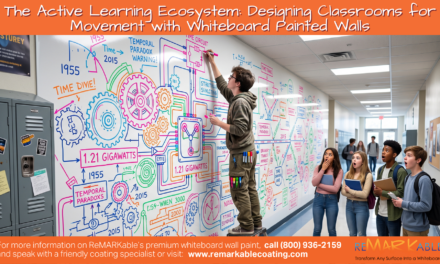
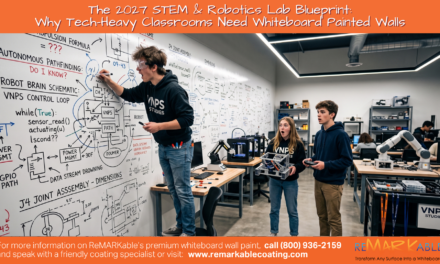
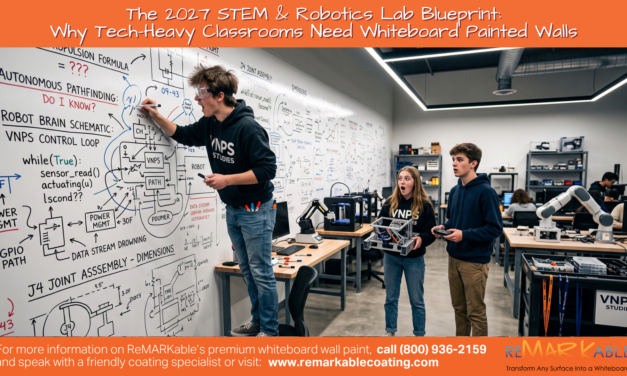
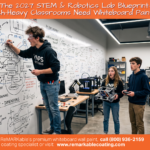
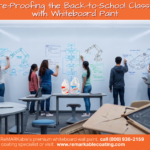
Conversely, stepping into a vibrant, kinetic environment where students are actively standing side-by-side, mapping out algorithmic logic and engineering wireframes across floor-to-ceiling whiteboard walls triggers an immediate, powerful paradigm shift. It visually proves that the institution prioritizes active learning, agile project management, and peer collaboration.
Parents want undeniable proof that their tuition investments or municipal bond dollars are directly funding an agile ecosystem that prepares students for the collaborative tech workforce. By replacing static, single-use educational furniture with expansive, interactive dry erase surfaces, school owners can completely rebrand a room’s physical culture. The visual psychology of a seamless, boundless writing surface creates a powerful, lingering impression of forward-thinking excellence long after the admissions tour concludes.
The Fiscally Responsible Retrofit: Overhauling the 1990s Computer Lab
Almost every established campus contains a spatial liability: the legacy 1990s computer lab, the awkward library study nook, or the windowless audio-visual storage room. In their current state, these areas represent massive, inefficient square footage. The conventional construction approach to modernizing these rooms involves hiring external general contractors to demolish built-in casework, repair old drywall, and install expensive, heavy digital interactive displays that will inevitably require costly software updates within five years.
A far more fiscally responsible and sustainable alternative is utilizing premium dry erase paint to upcycle the existing interior architecture. Because commercial-grade, two-part coatings are engineered to be self-leveling and molecularly bond to virtually any smooth, non-porous substrate, internal facilities teams can apply them directly over legacy structural elements without hiring specialized outside contractors.
High-Impact Architectural Upcycling Strategies:
- Repurposing Laminate Desks: Instead of paying disposal fees to haul away outdated laminate computer tables, maintenance crews can coat the flat tabletop surfaces. This instantly creates collaborative lab benches where robotics teams can sketch circuit schematics directly onto their desks.
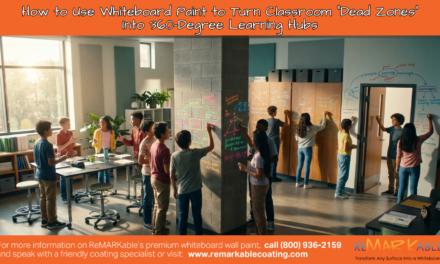
- Activating Structural Columns: Awkward, load-bearing concrete pillars that traditionally break up a room’s sightlines can be coated edge-to-edge, turning an architectural hindrance into a 360-degree brainstorming hub for breakout groups.
- The Continuous Perimeter Wrap: Rather than purchasing modular, prefabricated boards that leave awkward gaps of drywall, facilities teams can wrap the entire room perimeter in a continuous, uninterrupted writable canvas.
Spatial Pedagogy: Designing the 360-Degree STEM Innovation Lab
A high-functioning campus Makerspace thrives on the principles of design thinking, iterative testing, and rapid prototyping. To successfully execute complex STEM curricula, students require the physical freedom to stand up, step back, and view massive project matrices from a macro perspective. Traditional aluminum-framed whiteboards impose artificial creative ceilings; the moment a student hits the physical metal border mid-equation, the cognitive flow is broken, and the idea must be erased or compressed.
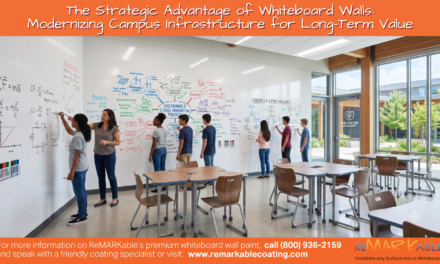
By investing in continuous whiteboard painted walls, campus administrators remove these physical barriers to conceptualization. The room itself becomes a dynamic, agile participant in the learning process.
Furthermore, applying dry erase coatings strategically allows administrators to establish distinct functional zones within a single open lab without constructing expensive drywall partitions that limit future room layout flexibility:
+-------------------------------------------------------------------+
|                        THE IDEATION WALL                          |
|  (Floor-to-ceiling dry erase paint for uncensored brainstorming)  |
+-------------------+---------------------------+-------------------+
|                   |                           |                   |
|   PROJECT MGMT    |    COLLABORATIVE DESKS    |     FIRESIDE      |
|      CORNER       |    (Coated laminate       |   PRESENTATION    |
|  (Kanban grids &  |     tabletops for rapid   |       SPACE       |
|   milestone logs) |     wireframing)          | (Coated K-12 wall)|
|                   |                           |                   |
+-------------------+---------------------------+-------------------+
Core Innovation Lab Zones:
- The Uncensored Ideation Wall: A dedicated, floor-to-ceiling wall span reserved entirely for open-ended brainstorming, where engineering students can map out the logic for a new software application or storyboard the mechanics of a physics prototype without space constraints.
- The Agile Project Management Corner: A perimeter section coated in high-gloss white and permanently gridded with thin vinyl tape to serve as a master Kanban board. Student teams can track sprint cycles, component delivery dates, and semester milestones from launch to final presentation.
- The “Fireside” Presentation Deck: A coated wall feature positioned near the front instructional podium where small groups can stand and defend their research hypotheses live, drawing and erasing structural diagrams on the fly during faculty critiques.
The Facilities Director’s Ledger: Curing the Campus “Ghosting” Epidemic
From an operational and auditing perspective, school business officials and facilities managers are evaluated on their ability to protect the institution’s long-term capital maintenance budget. One of the most frustrating recurring expenses in K-12 and higher education asset management is the cycle of replacing cheap, melamine, or standard porcelain boards that succumb to “ghosting.”
Ghosting occurs when the surface of an inferior board degrades and becomes microscopic-level porous, trapping dry erase marker pigments deep within the substrate. Within two years of heavy classroom use, these boards develop a permanent, dingy gray haze that resists standard cleaning, making the entire classroom look neglected.
When outfitting a high-traffic STEM facility, chemical durability is just as critical as initial aesthetic appeal. Commercial-grade dry erase walls are formulated with advanced, two-part polyurethane or epoxy cross-linking that cures into an impermeable, non-porous shell. This advanced chemistry ensures that even if a student leaves a dense, highly pigmented red dry erase diagram on the wall for the entire six-week winter recess, it will wipe away effortlessly in January without requiring harsh chemical solvents that damage indoor air quality.
The Total Cost of Ownership (TCO) Advantage:
- Elimination of Recurring Replacement Cycles: Instead of budgeting to replace thirty stained, ghosted boards every four years across a school wing, a single professional coating application provides a pristine writing surface engineered to withstand daily institutional abuse for a decade or more.
- Zero Masonry Disturbance Liability: In campus buildings constructed prior to 1980, drilling into old classroom walls to hang heavy mounting brackets carries the risk of disturbing encapsulated asbestos or lead paint. Rolling a liquid coating directly over existing, sealed drywall bypasses environmental containment red tape entirely.
- Universal Surface Compatibility: Premium coatings allow facilities teams to maintain a uniform design standard across varied campus architectures, adhering equally well to drywall, primed cinderblock, metal doors, and wooden cabinetry.
Implementation Protocol: The Back-to-School Weekend Rolled Retrofit
Because modern commercial dry erase formulas feature rapid cure rates and extremely low VOC (Volatile Organic Compound) profiles, a district’s internal summer maintenance staff can execute a multi-room Makerspace transformation over a standard two-day weekend without leaving lingering chemical odors that disrupt administrative operations.
- Friday Afternoon (Surface Sanitation & Masking): Custodial teams degrease target walls, structural pillars, and laminate tables to remove oils and dust. Painter’s tape is applied to create crisp, intentional architectural frames around light switches, fire strobes, and thermostats.
- Saturday Morning (Precision Application): Maintenance technicians combine the two-part commercial formula. Using high-density foam rollers, the self-leveling liquid is applied smoothly across the designated surfaces, filling minor drywall imperfections to create a glass-like plane.
- Sunday (Molecular Cross-Linking): The lab remains locked and climate-controlled while the coating undergoes rapid polymer cross-linking, curing into a hard, scratch-resistant barrier.
- Monday Morning (Administrative Handover): Masking tape is removed to reveal a sharp, integrated collaborative hub. The room is immediately ready for incoming faculty orientation and student campus tours.
Future-Proofing the Campus Architecture
As educational leaders finalize their capital allocation strategies for the upcoming school year, the mandate is clear: institutions must build spaces that foster kinesthetic engagement, spatial agility, and active problem-solving. Yet achieving this modernized standard does not require commissioning costly architectural redesigns or enduring months of disruptive interior demolition.
By viewing outdated campus assets through the lens of strategic upcycling and applying commercial whiteboard paint, administrators can systematically transform neglected computer labs into high-tech Makerspaces. You protect your annual maintenance capital, empower your faculty to teach at the cutting edge of modern pedagogy, and present prospective families with an inspiring, limitless environment engineered to build the leaders of tomorrow.



![Giant Leaps Forward Require Big Spaces. [Leap Year Sale Event!]](https://www.remarkablecoating.com/wp-content/uploads/2016/02/Giant-Leaps-ForwardRequire-Big-Spaces-440x264.jpg)



![30% Off St Patrick’s Day Sale! [Details Inside]](https://www.remarkablecoating.com/wp-content/uploads/2016/03/Glorious-1-440x264.png)

![Drive Your Organization Into Openness and Watch it Expand [20% Off Whiteboard Paint]](https://www.remarkablecoating.com/wp-content/uploads/2016/04/Drive-Your-Organization-Into-Openness-and-Watch-It-Expand.-1-440x264.jpg)
















![ReMARKable’s Winter Sale is Here! [25% Off + Free Shipping]](https://www.remarkablecoating.com/wp-content/uploads/2018/01/Red-Tag-Winter-Fashion-Facebook-Post-1-440x264.png)



![ReMARKable Summer Sale 2018 [28% Off Whiteboard Paint]](https://www.remarkablecoating.com/wp-content/uploads/2018/06/Blue-Simple-Line-Beach-Facebook-Post-1-440x264.png)
































































































































































0 Comments