
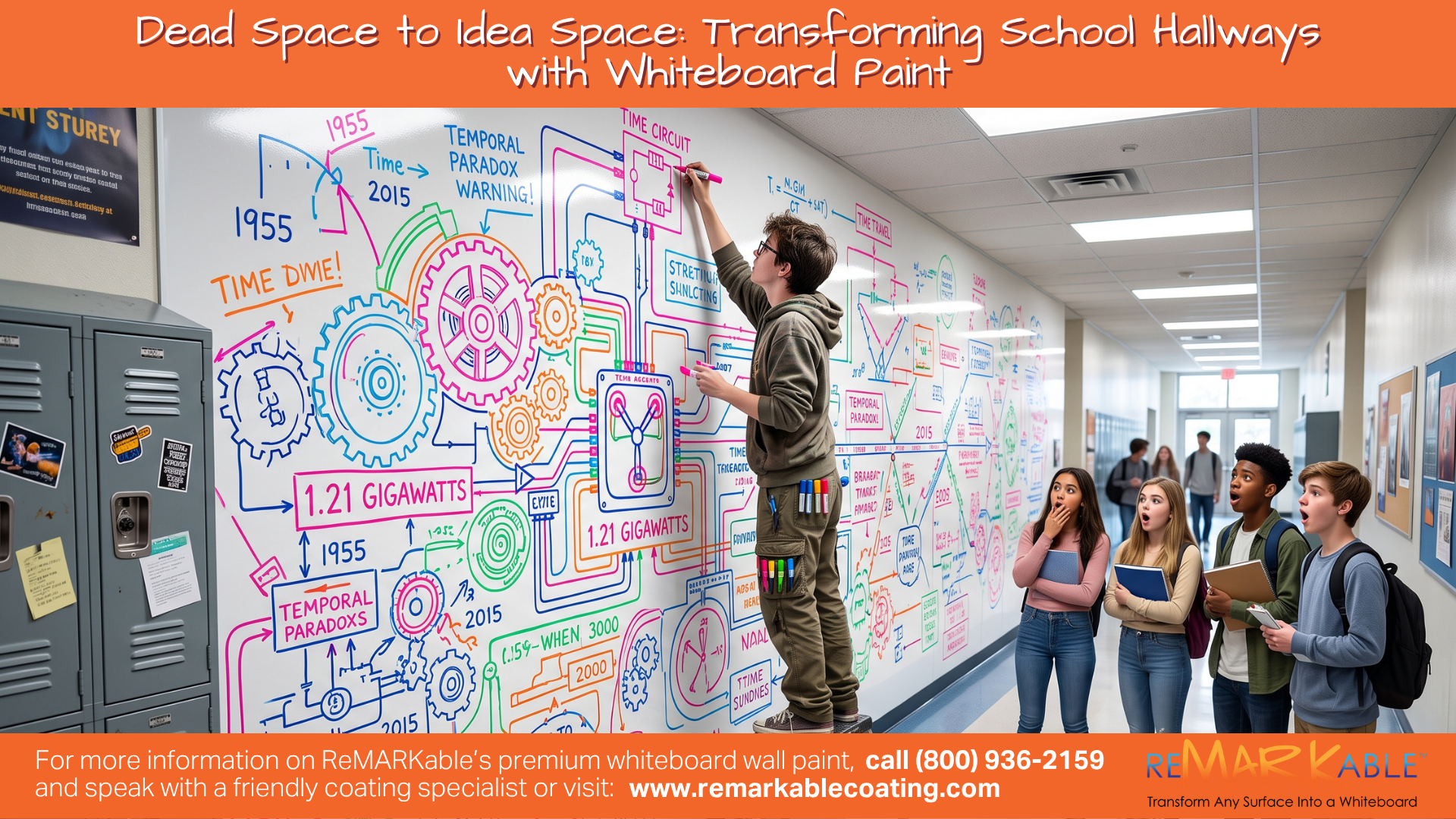
Transforming School Hallways with Whiteboard Paint
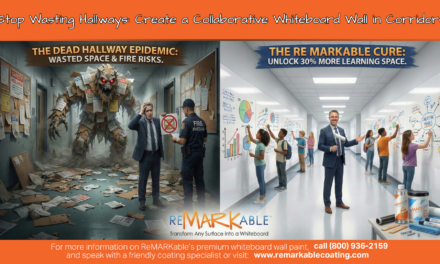
When campus administrators and facility directors evaluate their architectural footprint for the upcoming academic year, they often overlook a staggering reality: up to thirty percent of a school’s total square footage is dedicated entirely to hallways—but by utilizing premium whiteboard paint to create seamless whiteboard painted walls in these transit corridors, schools can instantly transform wasted dead space into vibrant, collaborative learning hubs. For decades, school corridors have been designed with a singular, utilitarian purpose: moving large numbers of students from Point A to Point B as quickly and quietly as possible. They are the essential arteries of the building, yet they have historically been completely devoid of educational value.
Architecturally, traditional hallways are barren, institutional tunnels lined with heavy metal lockers, scuffed linoleum, and rigid cinderblock boundaries. However, as modern educational philosophy aggressively evolves to mimic the highly collaborative, open-concept environments of modern tech incubators and Silicon Valley campuses, leaving a third of your building’s expensive real estate academically dormant is a massive missed opportunity. By reimagining these transitional areas as interactive, community-driven spaces, forward-thinking schools are pushing learning beyond the four walls of the traditional classroom, proving that education need not stop the moment the bell rings.
1. The Architectural Shift: Rethinking Circulation Space with Whiteboard Walls
To understand the sheer scale of this spatial opportunity, one must look at standard educational design guidelines. According to the Association for Learning Environments (A4LE) and historical data regarding campus facility planning, “circulation space”—which includes central hallways, stairwells, and entrance lobbies—consumes anywhere from 25% to 35% of a standard K-12 school’s gross square footage. In a sprawling high school campus, this translates to tens of thousands of square feet that serve absolutely no pedagogical function throughout the seven-hour school day.
Historically, this specific architectural design was born directly from the industrial-era factory model of schooling, which strictly prioritized order, single-file lines, and rigid bell schedules. The hallway was engineered as a place for transit, not for talking, and certainly not for thinking. Today, however, progressive pedagogy emphasizes the concept of “The Third Teacher”—a foundational philosophy originating from the Reggio Emilia approach to education, which explicitly states that the physical environment itself is a crucial, active instructor in a student’s daily academic journey.
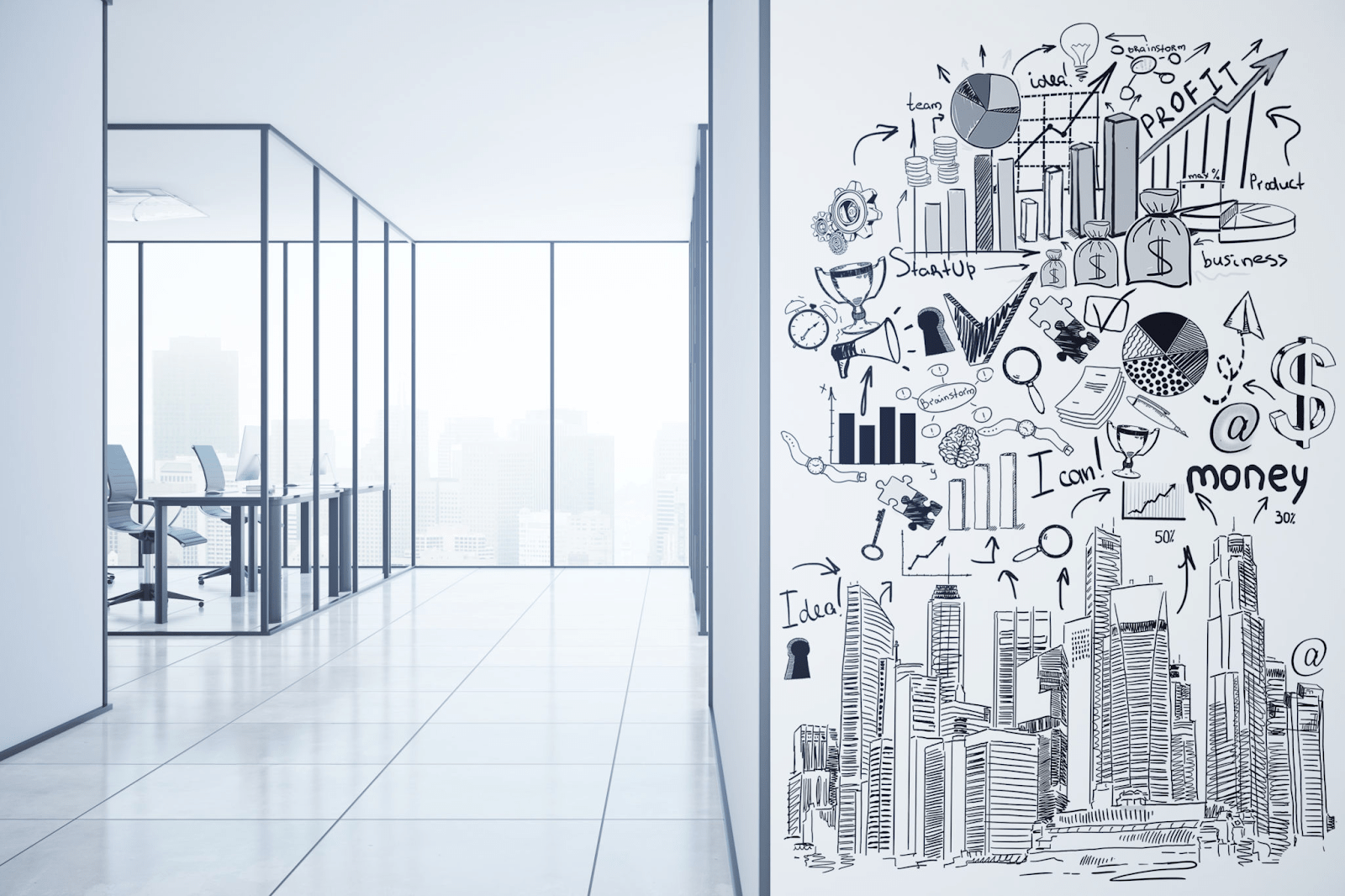
When a school begins to treat its physical environment as an active participant in learning rather than a passive container, blank corridors immediately become prime academic real estate. By coating structural pillars, quiet alcoves, and expansive corridor perimeters to create seamless whiteboard walls, facility directors fundamentally alter the psychology of the space. The hallway ceases to be a sterile transit tunnel and instead becomes a continuous, interactive canvas. This simple architectural upgrade sends a powerful, subconscious message to the entire student body: your ideas matter everywhere on this campus, not just when you are sitting quietly at a desk.
2. Fostering Informal Learning Zones using Dry Erase Paint
Pedagogical research shows that learning is inherently social, and that some of the most profound academic breakthroughs occur outside scheduled, formal instructional time. Walk onto any prestigious university campus or high-end corporate headquarters, and you will see “informal learning zones” scattered throughout the facility—small, comfortable, highly accessible nooks where people gather organically to discuss ideas, troubleshoot complex problems, and collaborate on projects. Progressive K-12 and higher education institutions are now aggressively adopting this exact corporate model to better prepare students for the modern workforce.
However, creating these designated collaboration zones in aging, existing school buildings can be incredibly challenging without initiating massive, budget-draining structural renovations. This is where the strategic application of commercial-grade dry erase paint becomes an invaluable, cost-effective facility hack. Instead of tearing down drywall to build brand-new breakout rooms, administrators can easily activate existing “dead ends,” wide corridor intersections, and awkward architectural alcoves.
Imagine a bustling high school hallway during a free period or lunch break. Instead of students sitting passively on the floor scrolling through their smartphones, they are clustered around a structural pillar that has been coated with a premium writable surface. A senior AP Calculus student is visually breaking down a complex derivative for a peer, mapping out the equation in bright blue marker directly onto the hallway wall. Across the corridor, a group of drama students are actively blocking out stage positions for the upcoming spring musical. Because the tools for collaboration are permanently embedded into the architecture, students naturally gravitate toward peer-to-peer tutoring and spontaneous brainstorming. The environment itself acts as a daily catalyst for academic engagement, seamlessly blending social interaction with high-level intellectual exploration.
3. Amplifying Student Voice: Community Boards and Whiteboard Wall Paint
Beyond academic tutoring and STEM collaboration, school hallways serve as the primary communication network for the student body. Historically, managing this communication has meant relying on messy, disorganized cork bulletin boards, peeling scotch tape, and thousands of printed paper flyers that inevitably end up littered across the linoleum floor. Not only does this create an immense amount of visual clutter and daily janitorial stress, but it also directly conflicts with the growing administrative push for sustainable, zero-waste campus initiatives.
Transforming common areas with whiteboard wall paint provides an elegant, highly eco-friendly solution for Associated Student Body (ASB) and Student Council communication. By designating specific, highly visible corridor walls as “Student Voice Hubs,” schools empower their student leaders to communicate dynamically and sustainably. Instead of printing five hundred wasteful, single-use paper flyers for an upcoming pep rally, homecoming dance, or charity drive, student leaders can design massive, vibrant, eye-catching murals and announcements directly on the wall.
Furthermore, these interactive community boards foster a much deeper sense of campus inclusivity. A student council can write an engaging “Question of the Week” on the wall—such as “What is one thing you are grateful for today?” or “What song gets you hyped for the weekend?”—and leave markers nearby for the entire student body to contribute their answers as they walk to their next class. This transforms a passive walk down the hall into an active community-building exercise, giving every single student, from the most outgoing senior class president to the quietest freshman, a highly visible platform to share their voice and feel genuinely seen within the campus culture.
4. NFPA Fire Codes and Spatial Efficiency: The Safety of Whiteboard Painted Walls
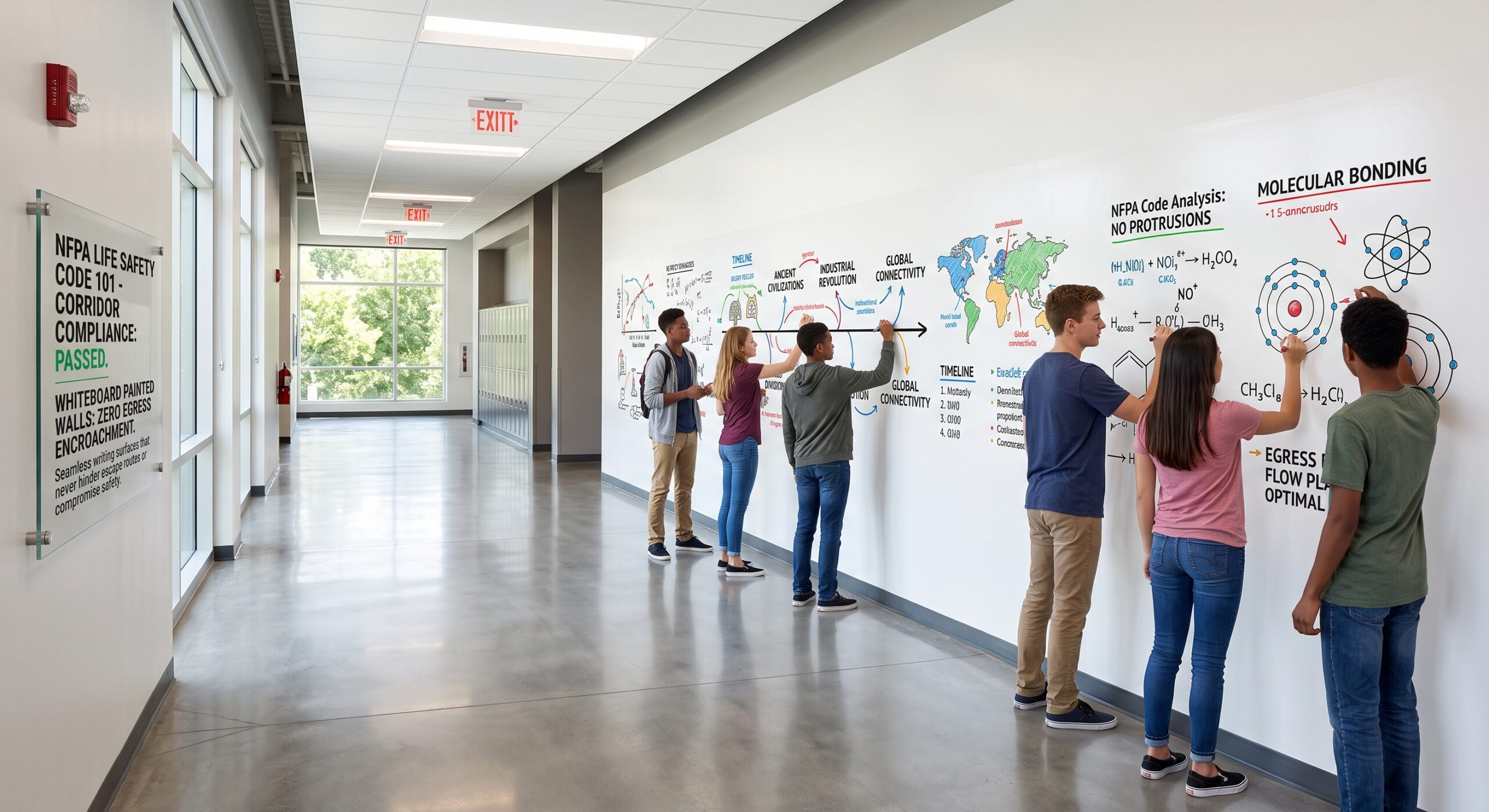
When discussing hallway innovations and placing new amenities in circulation spaces, campus facility directors and school safety officers must always prioritize strict building compliance above all else. According to the National Fire Protection Association (NFPA) 101 Life Safety Code, school corridors are officially classified as critical egress routes. This means they must maintain specific, legally mandated unobstructed widths to ensure the safe, rapid, and orderly evacuation of hundreds of students in the event of a fire or campus emergency.
Because of these highly stringent fire codes, schools cannot simply place traditional, bulky collaborative tools in their hallways to encourage learning. You cannot legally park a rolling whiteboard easel, a bulky interactive digital smartboard, or a protruding chart stand in the middle of a transit corridor; it immediately becomes a dangerous tripping hazard and a severe fire code violation that will result in a failed inspection. Even traditional, wall-mounted metal-framed boards can be highly problematic if their thick chalk trays protrude too far into the required egress pathway.
This is the hidden genius and administrative value of using seamless whiteboard painted walls for hallway activation. This specific product provides infinite, floor-to-ceiling writing utility with an absolute zero-inch physical footprint. Because the functional surface is painted directly onto the existing flush drywall, it does not encroach on the physical walking space by a single millimeter. Facility directors can confidently create massive, highly engaging interactive zones in their narrowest hallways without ever running afoul of the fire marshal or compromising student safety. It is the ultimate architectural fusion of visionary educational design and rigorous, uncompromising facility compliance.
5. Designing Interactive Art Corridors with Dry Erase Walls
The mental health, emotional well-being, and stress management of students are top priorities for superintendents and principals heading into the upcoming school year. Recent psychological studies regarding adolescent development show that providing creative outlets and opportunities for brief “micro-breaks” during the rigorous school day can significantly lower baseline anxiety and improve overall campus morale. Integrating interactive art into the daily transit experience is a powerful, highly visible way to achieve this mental health goal.
By dedicating long, uninterrupted stretches of corridor to dry erase walls, schools can create rotating, interactive art installations that benefit the entire student body. The school’s art department can take exclusive ownership of a “Mural of the Month” wall, where advanced studio art students use vivid, neon markers to draft intricate, large-scale masterpieces. Because the medium is inherently temporary and easily wiped away, the art is constantly evolving and adapting. It gives students a tangible reason to look forward to walking down that specific hallway to see what new, breathtaking creation has been added since yesterday.
Additionally, these frameless surfaces can serve as vital, low-stakes stress relief zones during high-pressure times of the academic year, such as final exam weeks or college application season. Guidance counselors can actively encourage students to doodle, draw abstract shapes, and write words of encouragement to their stressed peers between class periods. This simple, tactile act of kinetic, creative expression provides a much-needed mental reset, breaking up the deeply rigorous academic day with fleeting moments of joy, color, and spontaneous creativity that protect student well-being.
Step Into the Future of School Hallways
As administrators, architects, and educators blueprint the next generation of highly effective educational facilities, it is time to definitively stop viewing our campus corridors as mere transit pathways and start treating them as vital, active components of the overall learning ecosystem. A school’s physical architecture speaks volumes about its core institutional values. When hallways are barren, dark, and institutional, they convey that learning is a rigid, confined activity that occurs only under strict supervision. But when those same corridors are bright, interactive, and beautifully covered in student ideas, equations, and art, they boldly communicate that innovation, creativity, and intellectual curiosity are welcome everywhere.
By strategically expanding the educational environment beyond the classroom door, administrators can unlock thousands of square feet of entirely untapped potential, fostering a vibrant campus culture that truly prizes collaboration, environmental sustainability, and community engagement. You do not need to tear down structural walls, hire expensive contractors, or undertake massive, multimillion-dollar renovations to modernize your facility successfully; you need to rethink and optimize the blank surfaces you already have. Whether you are creating a Silicon Valley-inspired informal learning zone, a zero-waste, eco-friendly ASB announcement board, or an expansive interactive art corridor that supports student mental health, using premium commercial whiteboard paint is the most agile, cost-effective way to revitalize your real estate. The exciting transformation from a wasted dead space to a dynamic, buzzing idea hub starts with a single coat of whiteboard paint, proving without a doubt that the true heart of a modern, highly collaborative campus can easily be built with whiteboard painted walls.



![Giant Leaps Forward Require Big Spaces. [Leap Year Sale Event!]](https://www.remarkablecoating.com/wp-content/uploads/2016/02/Giant-Leaps-ForwardRequire-Big-Spaces-440x264.jpg)



![30% Off St Patrick’s Day Sale! [Details Inside]](https://www.remarkablecoating.com/wp-content/uploads/2016/03/Glorious-1-440x264.png)

![Drive Your Organization Into Openness and Watch it Expand [20% Off Whiteboard Paint]](https://www.remarkablecoating.com/wp-content/uploads/2016/04/Drive-Your-Organization-Into-Openness-and-Watch-It-Expand.-1-440x264.jpg)
















![ReMARKable’s Winter Sale is Here! [25% Off + Free Shipping]](https://www.remarkablecoating.com/wp-content/uploads/2018/01/Red-Tag-Winter-Fashion-Facebook-Post-1-440x264.png)




![ReMARKable Summer Sale 2018 [28% Off Whiteboard Paint]](https://www.remarkablecoating.com/wp-content/uploads/2018/06/Blue-Simple-Line-Beach-Facebook-Post-1-440x264.png)


















































































































































































0 Comments