

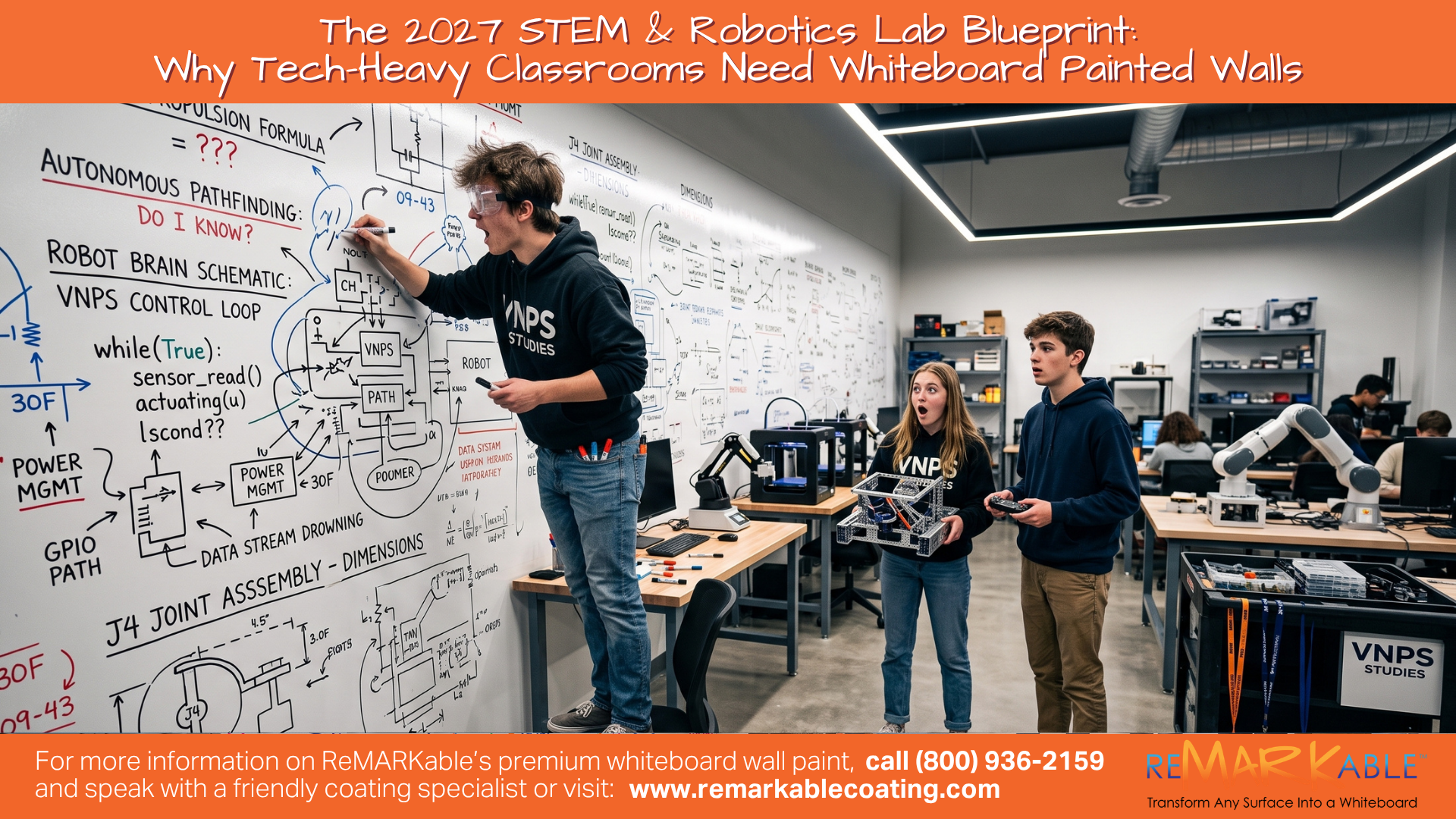
Why Tech-Heavy Classrooms Need Whiteboard Painted Walls
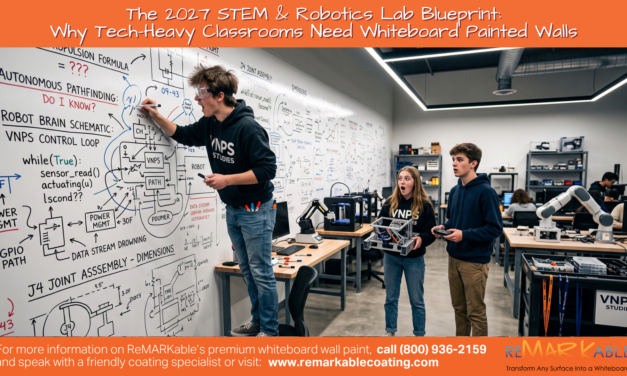
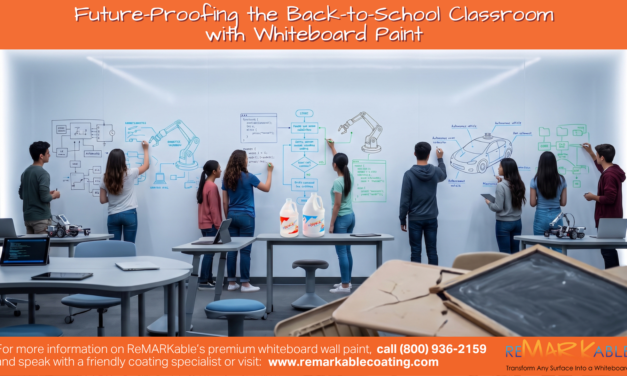
As high school administrators and district facility planners blueprint the academic spaces for the upcoming school year using whiteboard painted walls, a quiet revolution is taking place in the wing of the building traditionally reserved for science, technology, engineering, and mathematics (STEM). The modern high school STEM lab or robotics workshop no longer resembles the quiet, isolated chemistry labs of decades past. Today, these spaces mirror corporate research and development incubators, complete with 3D printers, laser cutters, microcontrollers, and high-performance computing stations. However, as the complexity of student projects skyrockets—from autonomous robotics coding to advanced aerospace engineering simulations—a glaring logistical bottleneck has emerged: traditional, small-scale writing surfaces can’t meet the cognitive demands of modern technical education. When students draft complex algorithms, troubleshoot intricate circuit schematics, or map multi-variable calculus proofs, a standard four-by-eight-foot framed whiteboard runs out of space in minutes. To future-proof a technical learning environment, schools must adopt an immersive infrastructure model that turns the physical room into an expansive, 360-degree digital-physical hybrid workspace.
1. The Cognitive Load of Complex STEM Problem-Solving
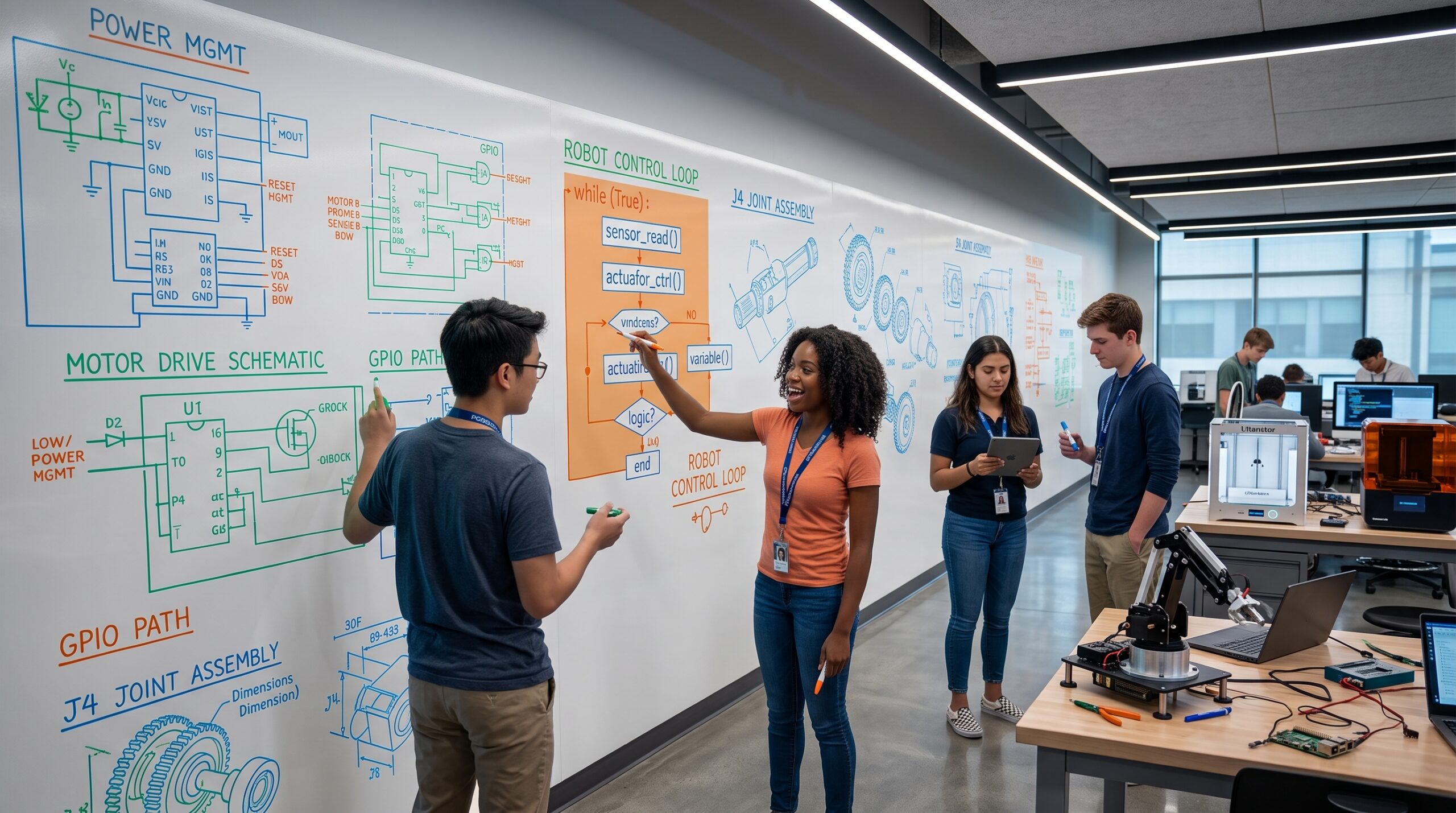
To understand why traditional classroom surfaces fail in a modern STEM setting, one must examine how technical problem-solving actually functions. According to cognitive load theory and educational research from engineering design institutions, complex problem-solving—such as writing clean Python code for a robotics actuator or mapping out structural load physics—requires extensive external working memory. Students cannot simply hold these multi-step variables in their heads; they must sketch, test, erase, and iterate on a massive visual scale.
In a standard classroom constrained by small, framed boards, students are severely restricted. A computer science teacher trying to demonstrate a recursive sorting algorithm quickly runs out of writing room, forcing them to erase crucial foundational logic to finish the equation. Similarly, student engineering teams working collaboratively on a mechanical design end up huddled around tiny, cramped notebooks or single laptops, completely losing the collective, spatial synergy required for breakthrough innovation. When a technical workspace is physically cramped, cognitive capacity is wasted simply managing the lack of space. Expanding the writing canvas to the entire perimeter of the room removes these physical boundaries, allowing students to think as expansively as their projects demand.
2. Replacing Obsolete Hardware with Seamless Whiteboard Walls
Historically, school districts have attempted to solve spatial shortages in science and tech labs by purchasing additional instructional hardware—rolling double-sided easels, electronic smartboards, or heavy glass whiteboards mounted with bulky metal standoffs. Unfortunately, in a high-traffic, equipment-heavy robotics lab, these additions create major operational hazards.
Robotics labs are filled with delicate machinery, soldering stations, raw materials, and heavy storage bins. Cluttering the floor with rolling easels creates dangerous tripping hazards and blocks emergency egress pathways, putting the facility at risk of violating strict municipal fire codes. Furthermore, electronic smartboards, while flashy, come with high maintenance costs, frequent software obsolescence, and screen sizes that are still far too small for a team of five students to collaborate on simultaneously.
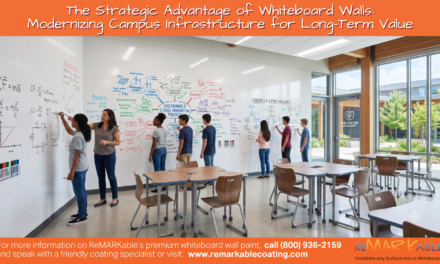
This is where transitioning to seamless whiteboard walls changes the entire architectural equation. By applying high-performance commercial coatings directly to the drywall, facility directors provide teachers and students with limitless, floor-to-ceiling vertical writing space that requires zero footprint on the floor. There are no protruding metal frames to bump into, no glass corners to chip, and no fragile electronic components to break. The room becomes instantly safer, cleaner, and infinitely more functional.
3. Creating Collaborative R&D Zones with Whiteboard Wall Paint
If you walk into a modern tech startup in Silicon Valley or a university engineering department, you will immediately notice one defining architectural feature: the walls are entirely writable. Glass partitions, corridor walls, and structural columns are coated or glazed so that engineers can stand up, grab a dry-erase marker, and map out system architectures wherever inspiration strikes. K-12 STEM programs must adopt this exact corporate R&D model if they want to adequately prepare students for higher education and the modern tech workforce.
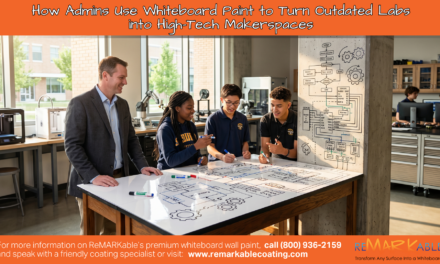
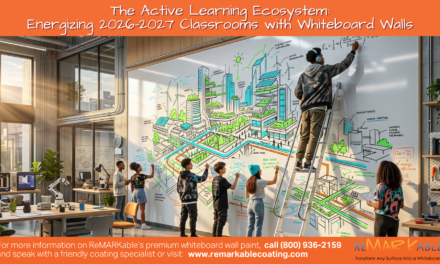
By applying durable whiteboard wall paint to the perimeter of a high school robotics lab, educators can establish distinct, collaborative “stations” without building expensive permanent drywall partitions. One wall section can be permanently designated as the “Logic and Coding Hub,” where students draft flowchart logic before translating it into machine code. An adjacent wall can serve as the “Mechanical Schematic Zone,” where teams sketch out gear ratios, chassis dimensions, and torque calculations. Because the surface is continuous and seamless, ideas can flow naturally from one student group to the next without being abruptly cut off by a metal frame or a corner of a room. This architecture of openness fosters a culture of radical transparency, peer review, and collective problem-solving.
4. Bridging Digital Code and Physical Design Using Dry Erase Walls
One of the greatest challenges in computer science and robotics education is helping students visualize abstract, invisible concepts—such as data packets moving through a network, variable states in an algorithm, or the kinematics of a robotic arm. While computer screens are essential for compiling code and running CAD software, digital screens are inherently isolating and limited in their field of view.
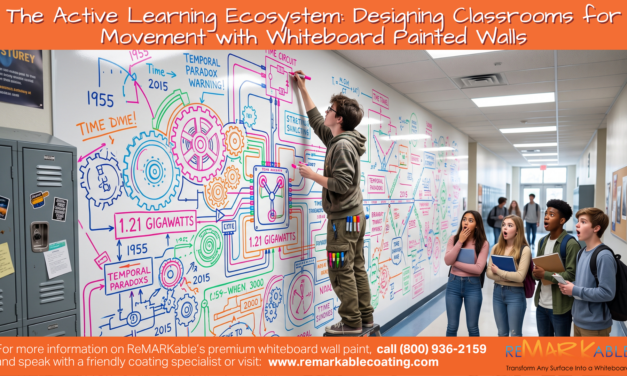
Expansive dry erase walls serve as the ultimate bridge between the digital screen and the physical build. Before a student team writes a single line of C++ code for their autonomous robot, they can map out the finite state machine on the wall, visualizing every sensor input and motor response in a massive, color-coded flowchart. If a logic error occurs during testing, the students step away from the computer, stand at the wall, trace the logic backward with a marker, and collaboratively debug the system in real time.
Educational research consistently shows that incorporating physical movement and vertical surface work into technical subjects drastically improves student comprehension and retention. By allowing students to step away from their keyboards and engage in kinesthetic, large-scale diagramming, schools create an environment where complex technical hurdles are cleared faster and with deeper conceptual understanding.
5. The Financial and Operational ROI for School Districts
For superintendents, STEM program directors, and school facility managers, investing in advanced lab infrastructure must be justified by clear financial stewardship. Upgrading a high school science wing or robotics lab requires careful capital allocation. However, the long-term Return on Investment (ROI) of architectural writable coatings far outperforms traditional instructional hardware.
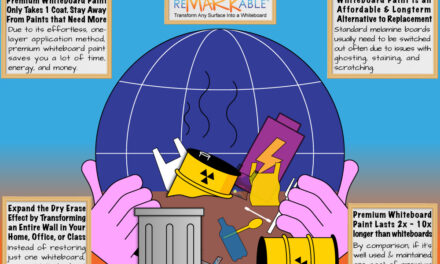
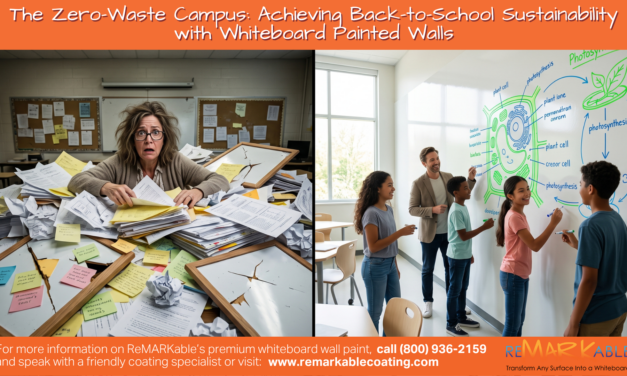
Traditional whiteboards and smartboards degrade rapidly in high-use environments. Melamine boards ghost and stain within a few short years, requiring expensive replacement cycles, while digital smartboards become obsolete or suffer costly hardware failures. In contrast, high-quality commercial writable coatings are engineered to withstand decades of heavy daily use by rigorous student engineers without losing their gloss or erasability. No hardware needs replacing, no software licenses need renewing, and no disposal fees go to local landfills.
Furthermore, by maximizing the usable utility of the room’s existing walls, districts avoid the high costs of structural renovations or buying expensive, space-consuming furniture. Money saved on hardware procurement and maintenance can be reallocated to advanced robotics kits, microcontrollers, 3D printing filaments, and specialized software licenses for students.
Architecting the Future of STEM Education
As educational standards continue to evolve toward rigorous, hands-on, project-based learning, the physical spaces where our students build the future must evolve in tandem. A state-of-the-art robotics lab cannot function effectively within the confines of an outdated, restricted 20th-century classroom layout. By removing physical boundaries, eliminating dangerous floor clutter, and embracing an open-concept architectural design, schools can empower their students to think bigger, collaborate deeper, and solve more complex technical challenges. Whether you are mapping out autonomous navigation algorithms, engineering mechanical chassis, or building the next generation of tech innovators, upgrading your facility’s vertical real estate with whiteboard paint is the definitive first step toward true institutional future-proofing.



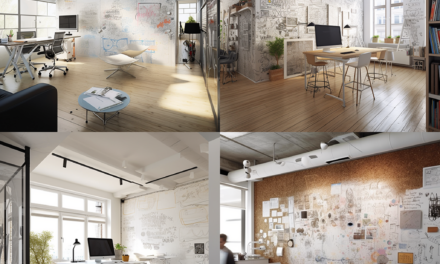
![Giant Leaps Forward Require Big Spaces. [Leap Year Sale Event!]](https://www.remarkablecoating.com/wp-content/uploads/2016/02/Giant-Leaps-ForwardRequire-Big-Spaces-440x264.jpg)



![30% Off St Patrick’s Day Sale! [Details Inside]](https://www.remarkablecoating.com/wp-content/uploads/2016/03/Glorious-1-440x264.png)

![Drive Your Organization Into Openness and Watch it Expand [20% Off Whiteboard Paint]](https://www.remarkablecoating.com/wp-content/uploads/2016/04/Drive-Your-Organization-Into-Openness-and-Watch-It-Expand.-1-440x264.jpg)















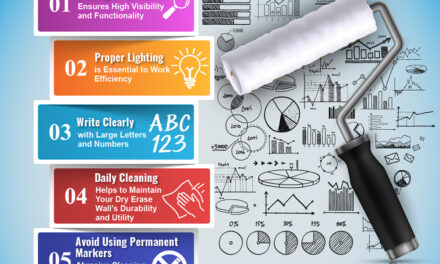
![ReMARKable’s Winter Sale is Here! [25% Off + Free Shipping]](https://www.remarkablecoating.com/wp-content/uploads/2018/01/Red-Tag-Winter-Fashion-Facebook-Post-1-440x264.png)




![ReMARKable Summer Sale 2018 [28% Off Whiteboard Paint]](https://www.remarkablecoating.com/wp-content/uploads/2018/06/Blue-Simple-Line-Beach-Facebook-Post-1-440x264.png)



















































































































































0 Comments