

Project-Based Learning and Design Thinking Using Whiteboard Paint for Classrooms
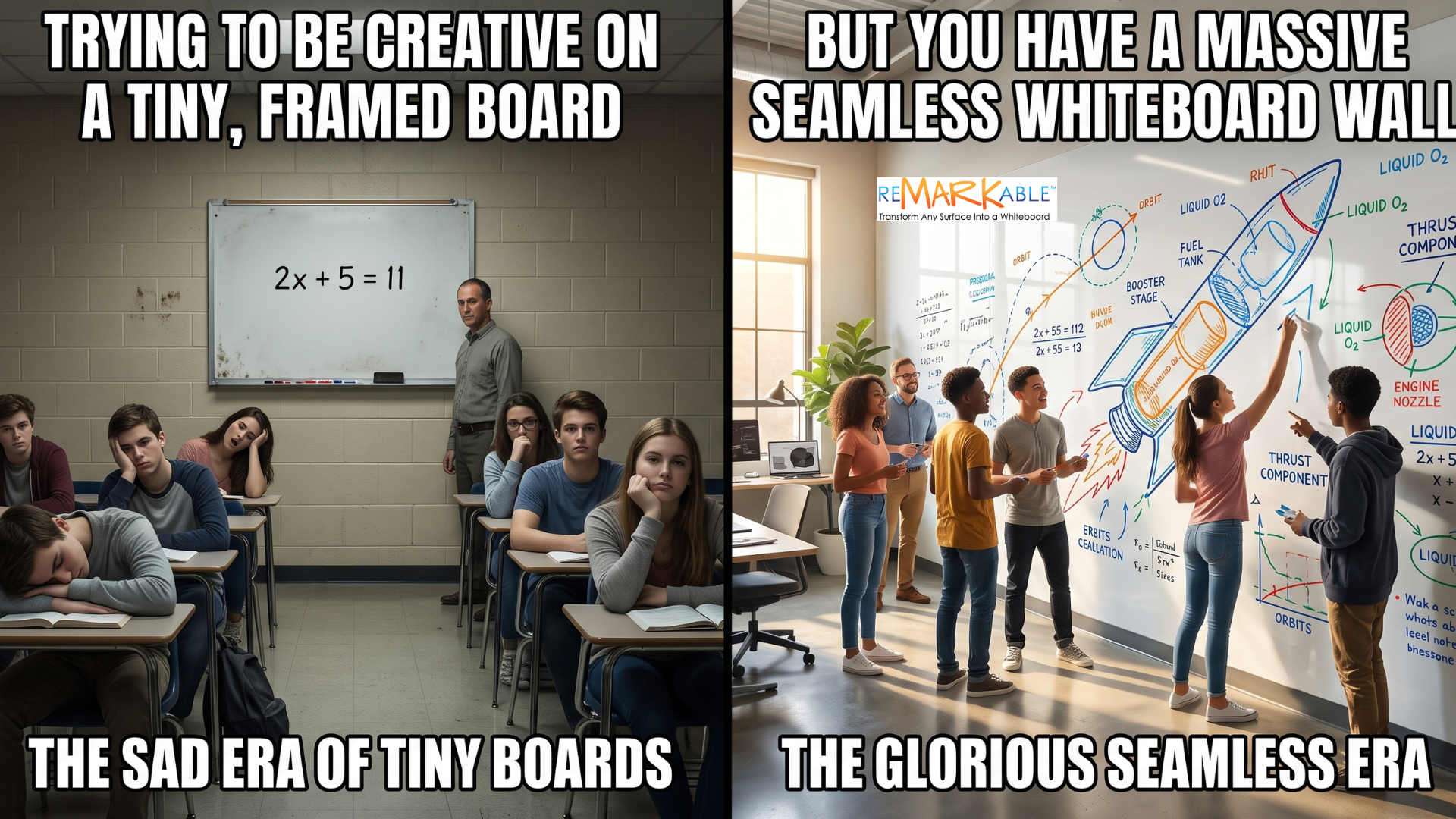
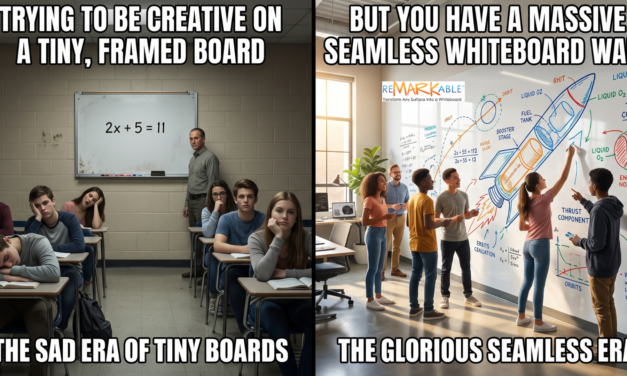
As educational paradigms shift from traditional lecturing to dynamic, student-centered methods, transforming classroom architecture with high-quality whiteboard paint has become essential for modern schools. For decades, the standard K-12 classroom was designed for passive knowledge reception: students sat in forward-facing rows, copying information from a small, restrictive framed board at the front of the room. Today, however, educational frameworks prioritize complex problem-solving, collaboration, and iterative design. To support modern pedagogical frameworks—such as Project-Based Learning (PBL) and Design Thinking—the physical environment must become a flexible, 360-degree collaborative studio. By replacing outdated, space-consuming hardware with seamless, floor-to-ceiling writable surfaces, educators can eliminate the physical boundaries that stifle creativity and build an environment where student innovation can truly thrive.
1. The Pedagogical Shift to Project-Based Learning (PBL) Using Whiteboard Walls
To understand why traditional classroom architecture fails modern students, facility directors and administrators must consider the demands of the modern workforce. According to the World Economic Forum’s Future of Jobs Report, the top skills required for the next decade include analytical thinking, complex problem-solving, creativity, and active learning. Rote memorization and standardized testing do not adequately prepare students for these demands.
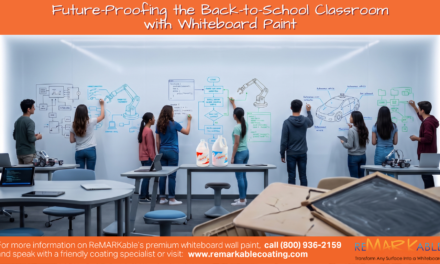
In response, leading educational institutions are adopting Project-Based Learning (PBL). As defined by PBLWorks (the Buck Institute for Education), Gold Standard PBL requires students to engage in sustained, collaborative inquiry to solve real-world problems. This pedagogical model requires extensive active brainstorming, mind-mapping, and peer critique. When a group of four or five students attempts to map out a multi-week community service project or a complex scientific inquiry, a standard piece of chart paper or a cramped 4×8 whiteboard is fundamentally inadequate. By coating the classroom perimeter in high-performance dry-erase paint, schools provide the expansive, unlimited canvas students need to map complex, long-term projects without constantly erasing their foundational ideas.
2. Integrating Stanford’s Design Thinking Framework on Dry Erase Walls
Closely tied to PBL is integrating “Design Thinking” into K-12 curricula. Pioneered by Stanford University’s Hasso Plattner Institute of Design (the d.school), Design Thinking is a non-linear, five-phase framework: Empathize, Define, Ideate, Prototype, and Test.
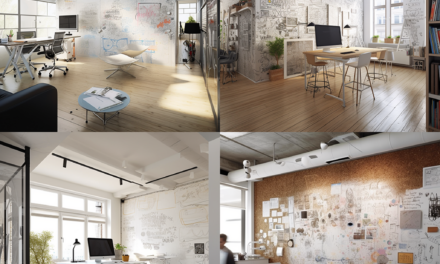
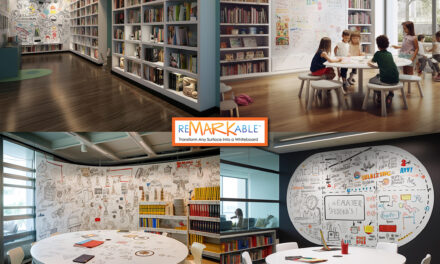
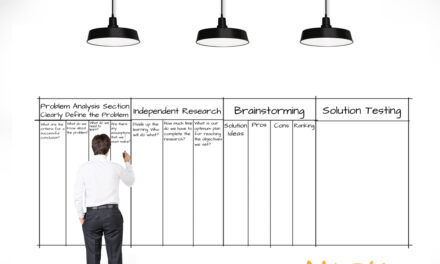
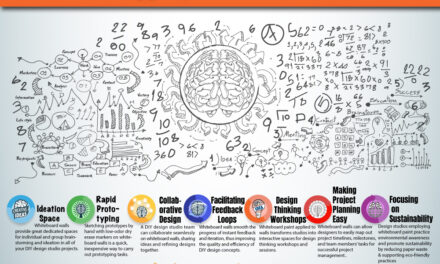
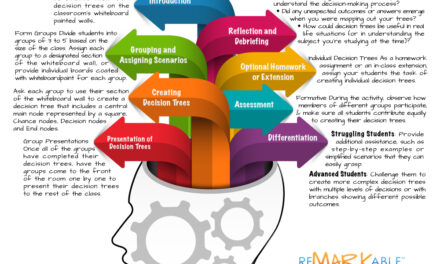
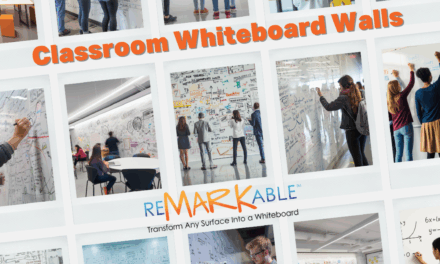
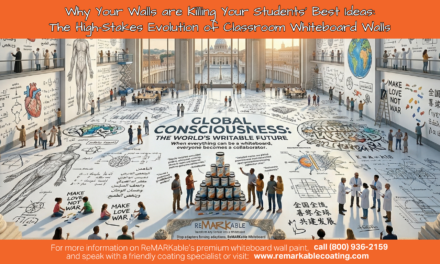
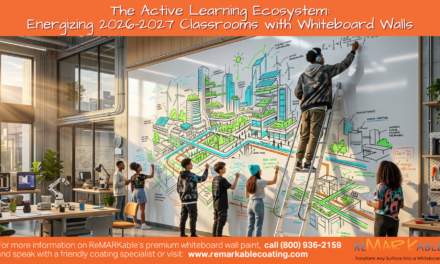
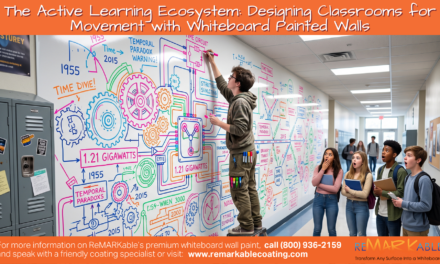
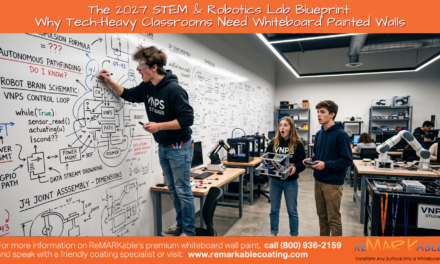
The third phase—Ideation—is where traditional classrooms severely handicap students. Ideation requires divergent thinking, where students generate as many wild, out-of-the-box ideas as possible before narrowing them down. In professional design studios and tech incubators, teams ideate on massive, writable walls where they can stand, move around, and visually connect disparate concepts. If schools want to teach students to think like world-class innovators, they must give them the same architectural tools. A continuous whiteboard wall allows student teams to dedicate specific sections of the room to different phases of the design process. They can list empathy interview notes on one wall, sketch prototypes on another, and track testing data on a third, immersing themselves completely in a 360-degree innovation ecosystem.
3. The Science Behind Vertical Non-Permanent Surfaces (VNPS) and Whiteboard Paint
The push for writable walls is not just an architectural trend; it is backed by profound cognitive science and mathematics education research. In his groundbreaking research framework, Building Thinking Classrooms in Mathematics, Dr. Peter Liljedahl conducted extensive studies on how physical surfaces affect student engagement and risk-taking.
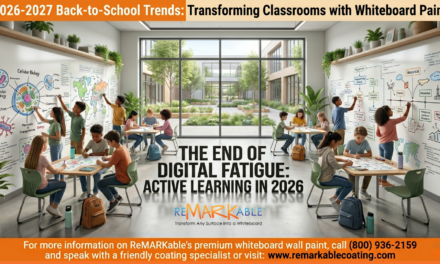
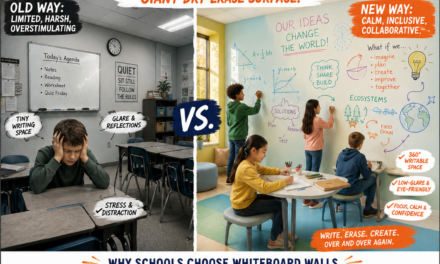
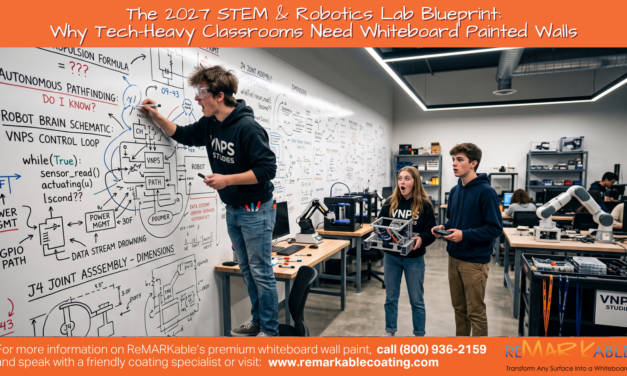
Liljedahl’s research decisively showed that when students work on “Vertical Non-Permanent Surfaces” (VNPS)—such as expansive dry-erase walls—they start tasks faster, discuss concepts more deeply, and persevere through difficult problems longer than when sitting at desks with paper or tablets. Because the surface is non-permanent, the fear of making a “permanent mistake” vanishes. If a student writes down an incorrect algebraic formula or a flawed hypothesis, they wipe it away and try again. This kinesthetic, standing-and-writing approach reduces cognitive friction, builds immense academic confidence, and transforms passive listeners into highly engaged, active participants.
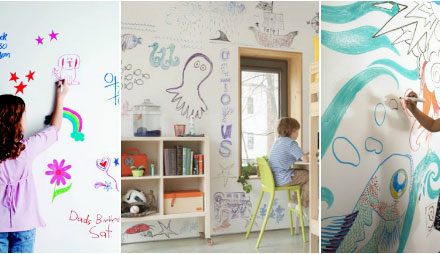
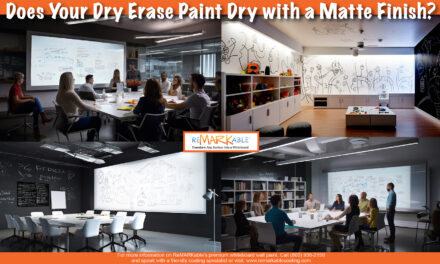
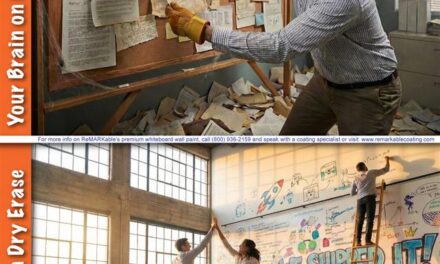
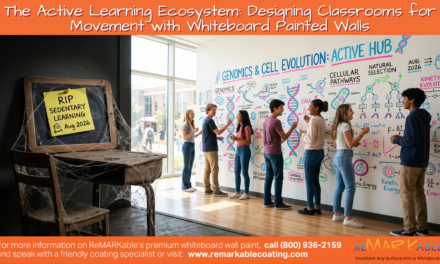
Watch how frameless whiteboard walls transform traditional classrooms into dynamic, active learning studios.
4. Tracking Agile and Scrum Methodologies with Dry Erase Paint
As Project-Based Learning becomes more complex, educators are borrowing project management frameworks directly from the software development and corporate sectors—specifically Agile and Scrum methodologies. Teachers teach students to manage their time, delegate tasks, and track long-term deliverables using Kanban boards (visual systems with “To Do,” “Doing,” and “Done” columns).
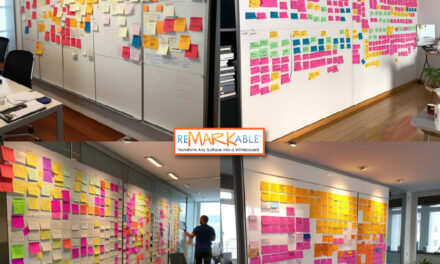
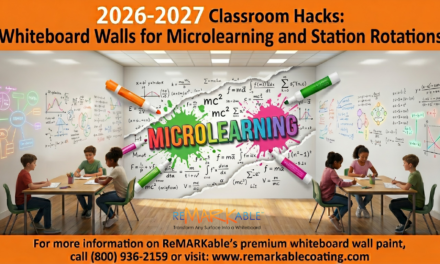
Managing a Kanban board on a digital screen hides the project’s progress from the classroom’s daily peripheral vision. Conversely, building a Scrum board on a traditional bulletin board requires messy pushpins, string, and constant maintenance. By utilizing a premium writable coating, educators can dedicate a permanent section of the classroom wall to project management. Students can draw massive Kanban grids, use dry erase markers to track shifting deadlines, and place sticky notes directly onto the glossy surface. This highly visible, interactive project tracking supports students with executive functioning challenges by keeping critical deadlines and responsibilities front and center at all times.
5. Eliminating Spatial Constraints with Frameless Whiteboard Wall Coatings
A major logistical hurdle for school facility directors is managing physical square footage while supporting these collaborative methodologies. Many school buildings feature overcrowded classrooms, leaving very little room for bulky instructional equipment. To compensate for limited wall space, some districts buy rolling glass easels or heavy, dual-sided chart stands.
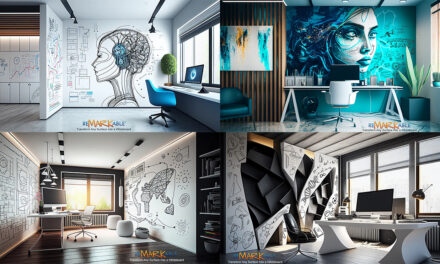
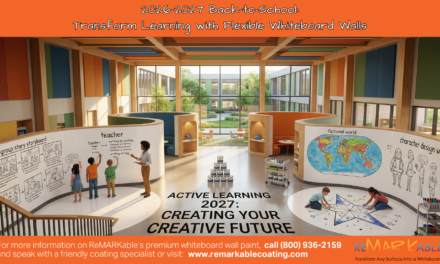
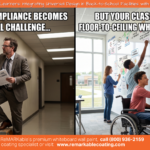
Unfortunately, these temporary items often create dangerous tripping hazards, block emergency egress pathways, and violate strict National Fire Protection Association (NFPA) and ADA compliance codes. Strategically applying whiteboard-painted walls solves this spatial crisis. Because the writable surface is integrated directly into the foundational drywall, it provides infinite, floor-to-ceiling utility with zero physical footprint on the floor. Facility directors can create large interactive zones without encroaching on walking paths, letting teachers push modular desks aside and instantly turn a cramped room into a spacious, open-air collaborative studio.
6. Supporting Neurodiversity and Cognitive Mapping on Seamless Writable Surfaces
Modern classrooms must account for the staggering rise in neurodivergent student populations, including learners with ADHD, dyslexia, and specific executive functioning differences. For many of these students, trying to organize complex, multi-step PBL projects on a small digital screen or a lined sheet of paper creates profound cognitive overload.
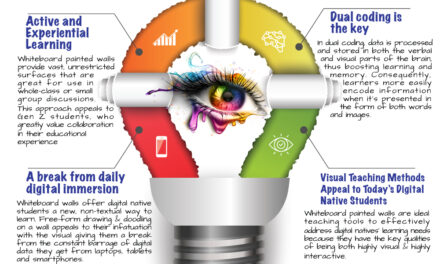
According to Dual Coding Theory, developed by Allan Paivio, human cognition depends heavily on combining verbal and visual information. Expansive dry erase walls serve as a massive external hard drive for a student’s working memory. Teachers and students can use color-coded markers to break down overwhelming assignments into digestible, highly visible mind maps. This spatial organization helps neurodivergent learners track multi-step projects independently, reducing anxiety and fostering a profound sense of self-regulation. Premium matte-finish coatings also reduce overhead glare, creating a visually calm environment that prevents the sensory exhaustion often associated with bright digital smartboards.
7. The Financial ROI of Upgrading to Commercial-Grade Whiteboard Paint
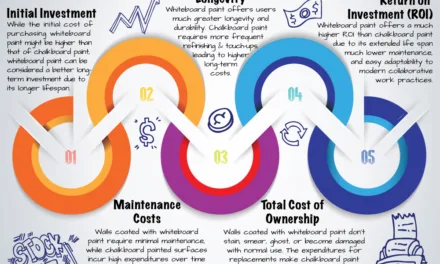
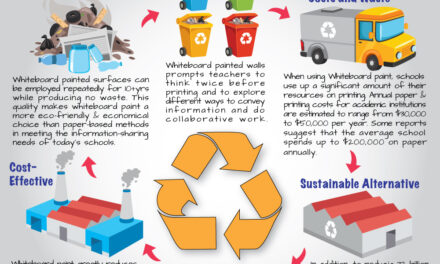
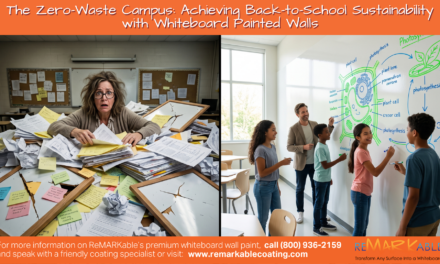
For superintendents and district facility managers, every infrastructural upgrade must be justified through careful financial stewardship. The traditional cycle of procuring, maintaining, and replacing classroom hardware is notoriously wasteful. Standard melamine whiteboards degrade rapidly, becoming heavily “ghosted” and permanently stained within a few short years. This traps schools in an endless cycle of unbolting ruined boards, paying municipal landfill disposal fees, and repurchasing identical replacement hardware.
Investing in commercial-grade dry erase paint breaks this expensive cycle entirely. High-performance, water-based coatings are engineered for extreme durability and designed to withstand decades of rigorous daily use by thousands of students without losing gloss or erasability. There are no fragile frames to bend and no hardware to replace at the end of the academic year. Over a facility’s lifecycle, the initial investment yields a staggering Return on Investment (ROI), eliminating recurring hardware costs and drastically slashing the district’s consumable paper budget.
The Financial ROI of Upgrading to Commercial-Grade Whiteboard Paint
As educational standards evolve, the physical spaces where our students learn must evolve with them. A successful transition to Project-Based Learning and Design Thinking requires more than just new curricula; it demands an intentional commitment to creating resilient, flexible, and inspiring physical environments. By removing outdated constraints, eliminating floor clutter, and unlocking the full potential of your vertical real estate, you empower educators to teach without boundaries and students to collaborate without limits. This academic year, take the definitive step toward institutional excellence and future-proof your classrooms with the boundless power of whiteboard paint.

























































































































































































0 Comments